

Archive for category Space Planning
Culture House – the Sound of Library Planning
Posted by acohen in Library Planning Research, Space Planning, work in progress on May 30th, 2013
It turns out that the noise level in the social “library as place” can be a positive factor in the learning environment. The library can be a social and active place to generate creative ideas as long as the sound level is just right. According to a study, “Is Noise Always Bad? Exploring the Effects of Ambient Noise on Creative Cognition” by the University of British Columbia and the University of Virginia ambient background noise turns out to be an important factor affecting creative cognition among learners. Noise levels at around 70 decibels, equivalent to a passenger car traveling on a highway, enhances performance on creative tasks and increases the likelihood of creative innovation.
Ravi Mehta, Assistant Professor of Business Administration, stated in “Too much, too little noise turns off consumers, creativity” that “a moderate level of noise not only enhances creative problem-solving but also leads to a greater adoption of innovative products in certain settings.” Mehta and co-authors Rui (Juliet) Zhu, of the University of British Columbia, and Amar Cheema, of the University of Virginia, explored how a moderate-level of ambient noise helps create a positive pattern of behavior.
The noise study found that there’s an inverted-U relationship between noise level and creativity. It turns out that around 70 decibels is the sweet spot. If you go beyond that, it’s too loud, and the noise starts to negatively affect creativity. It’s the Goldilocks principle – the middle is just right.
Our planning team works with sound experts to enhance the library / learning commons. We analyze how noise can create positive learning environments. We analyze the impact of sound on the learning environment. For example, our partner Charlie Morrow from Morrow3D sound studies how to integrate noise into international museum exhibitions.
We know that our clients need sound expertise and knowledge during library planning. This expertise in library, learning commons and museum environments is very important when there is not enough square footage for the community. The noise creates a negative friction that hurts the overall life the library and/or learning space, requiring a knowledgeable team to support planning efforts. Spaces that are planned with the high levels of noise (85 decibels), require a solid program and sound management plan.
Shifting Libraries to Mobile to Support Online Learning
Posted by acohen in Library Planning Research, Space Planning on May 16th, 2013
As library users shift transactions to smart phones and other mobile devises, libraries must anticipate how library users will anchor their cloud-based relationship to a real study environment. We are tracking the transition from local to mobile in our study of libraries and research environments.
Yesterday, The Georgia Institute of Technology College of Computing announced that it will offer the First Professional Online Master of Science Degree in Computer Science (OMS CS). The course will allow students to earn credits completely through the “massive online” format, using Udacity Inc.
We believe this is an example of a transformation in higher education away from traditional models of learning to more dynamic approaches. We believe the library will be critical to student success at Georgia Tech both as a virtual space and a physical academic support environment. For example, the library will act as a flipped classroom; a concept that enables the learner to prep before they enter the classroom physical or virtual.
The flipped classroom learning strategy combined with a learning commons enhances learning activities. It enables students to be infused in the learning experience while they use their mobile learning device wherever they are located. It allows students to meet in the library for programs, labs and study groups – opportunities to build social networks.
On October 26, 2013, ACA will be doing a library planning workshop at Georgia Institute of Technology. In preparation for this event, we are asking for input on the question – “what is the idea of the library?”
In all of the discussions about online learning and MOOC’s, we need to remember the personal one-on-one exchanges that can happen in a library or learning commons. There can be skills building opportunities, activated by people sharing a space. It can be a visualization space with flexible technology, tables and seats on casters. It can also include media / technology carts and/or booktrucks with pre-arranged materials.
Last year, ACA did two library planning projects with Gensler. Both were opportunities to share our library programming and design services. Recently, we noted an article in Dialog – A Gensler Publication – about the transformation taking place in the banking industry. Below is a diagram from their publication.
Visualizing the Library of the Future
Posted by acohen in Library Planning Research, Space Planning, work in progress on April 17th, 2013
NC State developed a wonderful video for their new library project. The video shows all of the different programmatic components required for a modern academic library including socializing, preservation and late night study.
Librarians can develop a proactive position when facing the future. Review this video to reflect and visualize the types of interactions and technology that can be in a library.
In a world of homogenized choices, the library can be the space where your community can feel truly fulfilled in their quest for knowledge, enlightenment, entertainment and connection to others.
The Library is an Incubator for Applied Design
Posted by acohen in Library Planning Research, Space Planning on March 6th, 2013
Paola Antonelli was on the Colbert Report to talk about Applied Design, an exhibition running at New York’s Museum of Modern Art. Paola is the senior curator of the Design and Architecture department, focusing on a new way to look at space.
Paola Antonelli has some great insights on the future of learning spaces, which really resonates with our library planning team. For example, Paola Antonelli stated – “The idea of having this research and development at a museum is about trying to figure out truly what kind of position the museum has to take on the inside and the outside for the future. My basic thought is that museums are, together with schools, the R&D of society. It’s about this chain of research and understanding.”
Our view is that the Library is an incubator for Applied Design. It is a place where the chain of research and understanding can be successfully implemented. The library is in a unique position to allow learning activities to exist. It serves the function of R&D in our society and should be encouraged.
Learning Circle – Library as an Incubator for Online Learning
Posted by acohen in Library Planning Research, Space Planning on February 18th, 2013
The library is no place to dream small. It is an incubator that when heated at the right tempature evolves into a place for education in the 21st century. The “Library as place” where a new concept for online learning is emerging; the barriers to education are being lowered. The library is a universal place that lets learning grow.
Libraries exist not just to lend books but to guarantee their continuous availability of access to information. In “Digital Education“- MIT technology Review January/February 2013 stated – “The highest ambition of any society is to educate its citizens.” Indeed, a simple group circle or shape speeds up our ability to perceive the learning space, and without realizing it, we are more productive.
In NYTimes Article “Why We Love Beautiful Things,” German Researchers’ found that just glancing at shades of green can boost creativity and motivation. However, we know people see things differently. To get it right, Professor Sanjay Sarma at MIT will serve as a convener and synthesizer to develop and integrate elements of online education into traditional MIT courses. It will be his job to create shades of green for students to get the most out of their education.
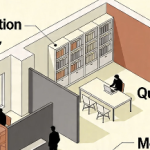
For example, the library of the future is an incubator: When you enter a flexible learning place—Enter—See—Access Services–Hi ceiling—Visibility–Stand-up-table–Tools—Screens—Screens on the edges.
The Consultation Bar is in the rear—Tutoring—Workshops—Mentoring–Peer Learning—-Touch points—One too one—-a place for flexible learning—Web browser—To view video—Questions to be
answered—Homework—Forums.
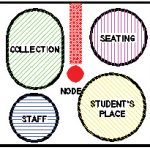
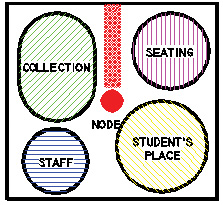
The model is a series of circles—each circle is a learning circle a place flexible learning—–start programming.
NYPL Library Planning – looking toward the future..
Posted by acohen in Library Planning Research, Space Planning, work in progress on February 4th, 2013
The NYPL is a unique library institution with a historical research component as well as a public center of culture in New York. Over the years, the public library has evolved into a “culture house” – a place for community gathering, electronic collaboration and cultural programming/events. However, digital projects live everywhere! This extreme decentralization of library and information services adversely affects the value of the library building i.e. when it looses touch with the strategy the building was designed to support.
In Renderings for a Library Landmark, Stacks of Questions, Norman Fosters design for the renovation of Manhattan’s 42nd Street branch of the New York Public Library is taking a bad rap. In this age of the Internet and e-books, libraries must change if they are to survive. No one wants to support an institution that does not offer collaborative space, research services and facilities to enhance culture – in this case New York City, the Big Apple and the Melting Pot.
Although they were once important aspects of New York Public Library’s organization, the time has passed for the Mid-Manhattan and Business Libraries. Library services and culture has changed; so the design strategy must change. We say this even though Aaron Cohen, AIA and Elaine Cohen, Ed were once authors of an architectural program for a major expansion of the Mid-Manhattan Library and on the team that evaluated the pros and cons of the storage facility under Bryant Park before it was constructed.
Below are examples of Norman Fosters work – the Boston Museum of Fine Arts. It is an example of the grand space Norman Foster will design to enhance the 42nd street library.
The library planning equation and the NYPL example – The library of the future is part Bookstore, MakerSpace and Culture House
Posted by acohen in Library Planning Research, Space Planning on December 27th, 2012
The Library is still defined as a place that holds knowledge. We noted today that books are still part of the library planning equation. According to Libraries See Opening as Bookstores Close – NY Times December 27th article by KAREN ANN CULLOTTA – “As librarians across the nation struggle with the task of redefining their roles and responsibilities in a digital age, many public libraries are seeing an opportunity to fill the void created by the loss of traditional bookstores.”
The library will always be a space with books, knowledge resources (librarians), training, programs and quiet reading spaces. However, the spaces being allocated to books are being redefined, which makes our work challenging.
Books are still and will always be a knowledge tool of choice for many people. We recognize this fact as we plan tomorrows library collections. We also plan that libraries will be MakerSpaces and Culture Houses and Bookstores of the future. These strategies will continue to be priorities in our planning for 2013.
The ‘library is a place’ that should offer culture, knowledge tools and space to use for digital bits and physical atoms. Indeed, it will need to support all options for research.
The new library plan for the NYPL is a very exciting concept with new space designed for learning activities. The big challenge for the NYPL is to create a blended learning environment, not just a vast open room full of computers, but also spaces with books, media and historical resources. Flexible areas with movable partitions and bookstacks with books to check out need to be integrated into Foster’s plan.
Click on the link below – it is an impressive flyover of the new library planned for NYPL by Norman Foster…
NYPL – Library Plan
Transforming the Library Environment with New Furniture
Posted by acohen in Library Planning Research, Space Planning, work in progress on October 25th, 2012
Howard University is going through a transformation of its Undergraduate Library and Founders Library. The objective is to enhance the capabilities of the libraries as learning spaces. Our team has been testing furniture in the library environment to learn about student behavior. The product demos allow our team to test how students will work with the new furniture in the library. It helps the library staff define what types of furniture will transform the environment.
Examples of library collaboration in action including space for individual and group workstations help our team define the requirements for the new design.
Below are pictures of the library design & furniture demo.
Bishops School Library
Posted by acohen in Library Planning Research, Space Planning on October 20th, 2012
Boutique Zones in Libraries Create Desintations for Learning
Posted by acohen in Library Planning Research, Space Planning, work in progress on October 3rd, 2012
A recent article about JC Penny’s transformation into a series of boutiques is noteworthy to library consultants, librarians and architects. The former Apple retail chief Ron Johnson is trying to transform the physical space plan at JC Penny. He is changing the JC Penny retail environment into a series of focal points – boutique spaces that attract more involvement with the brands and the customers. This creates new opportunities for interactions with the product(s).
JC Penny’s intends to RFID all the items in the store, creating opportunities for mobile retail environments. The idea is to create different boutiques that can be transformed annually in an efficient way, leveraging RFID’s advantage as an accurate way to keep track of your products.
The use of RFID as a way to keep the product in a system that is mobile in nature is intriguing. RFID allows management to move or change the location of the product to any part of the store at anytime during the year. For example, Christmas requires a change to the environment to reflect the holiday spirit. Johnson’s strategy is to enable the store manager to redesign the space efficiently without doing an inventory each time it occurs.
PC Penny’s plans remind us that the RFID chip can be used to create a flexible “library as place”, keeping inventory control in an orderly manner and adapting to the needs of the community on an quarterly or annual basis. The strategy enables the library to be changed without a large redesign investment i.e. knowing where each book is placed gives the library staff an opportunity to move the collection around without being concerned about inventory control.
A flexible library environment is more vital today than ever before, because spaces for quiet study, collaboration and computer access are increasingly filled with patrons in need of workspace. Indeed, patrons are using the library’s environment more and more to excel in research. They are using the library for group meetings and any number of activities. However, the library buildings are limited by inflexible designs of the past – static books, lots of walls, poor inventory control and fixed furniture.
To truly create the learning environment that is needed today, librarians and educators need to think of ways to create flexible spaces on a quarterly or annual basis. For example the seating areas for quiet study don’t need to change often, but the group spaces and program areas need to be flexible for different sizes of groups. They need to be flexible for different modes of learning on a continual basis. Libraries that don’t have these types of building programs become static and inefficient.
The library needs strategies to support the “endless demand for quiet spaces” and the “endless demand for group activities.” The boutique zones strategy by Ron Johnson at JC Penny, creates new opportunities to manage the stock (inventory) in an efficient way, creating a retail environment that will be in constant motion. This long term strategy looks promising for libraries that start to harness a flexible building program and design. If they already have RFID, they can use this technology to develop flexible zones in their building; programs that leverage mobile technology to keep the library space in constant motion.