Archive for category work in progress

Education is Changing – Libraries Enhance Learning Support

Library buildings can be designed to enhance learning support and research. Librarians can support the workflow of their researchers by directly supporting, managing and aggregating the content. These days there are plenty of librarians preaching community, but what about how we can design libraries to enhance the digital world?

Libraries are places where solutions are possible through access to knowledge and higher education. Planning learning environments requires us to be aware of new opportunities in education technology, open-source software or open-access publishing.

According to “Open Online Courses – an avalanche that might just get stopped“- In the US, the growing chorus for online education through massive open online courses, or moocs, has been deafening.” For example, the California legislature created a bill for the “New University of California” – one that offered no instruction but would issue credentials to people merely for passing exams. Does this model assure that our students are learning in the online world?

The New University of California bill did not pass, but California lawmakers detailed a plan on May 8, 2013 to require the state’s 145 public colleges and universities to grant credit for low-cost online courses offered by outside groups, including classes offered by for-profit companies.

The bottom line is that there really is no replacement for face-to-face interaction between teachers, professors, librarians and students. Digital and online methods can enrich those interactions, but it is no match for the community of services at our Universities and Colleges provide; the community of professors, tutors, peer mentors, librarians, IT help, libraries, computers labs, disability services and academic support.

It seems unlikely that libraries and learning spaces can be replaced by online learning without considerable investment in electronic resources. No wonder 72% of those who have taught moocs over the past three years believe students who took their classes had not done sufficient work to deserve credit from their institution.

Libraries and Learning Commons can be created with clusters of valuable and distinctive services. Librarians can ensure that the learning environment, enhances the reputation of the community, faculty and the institution. Librarians will continue to ask – What services does the community need? How can their output be preserved, discovered and re-used?

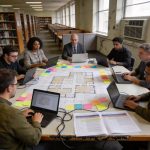
You can think of the Learning Commons as an incubator. It is an “I-Lab” – a multifunctional and fluid space for learning. The photo below is a visualization board that is at the Mathematics Museum in New York. It is an example of a physical environment that will support online learning technologies.

http://momath.org/

, , , , , , , , ,

No Comments

Visualizing the Library of the Future

NC State developed a wonderful video for their new library project. The video shows all of the different programmatic components required for a modern academic library including socializing, preservation and late night study.

Librarians can develop a proactive position when facing the future. Review this video to reflect and visualize the types of interactions and technology that can be in a library.

In a world of homogenized choices, the library can be the space where your community can feel truly fulfilled in their quest for knowledge, enlightenment, entertainment and connection to others.

, , , , , ,

No Comments

As Search Goes Mobile, Apps Change the Way We Use the Library

A couple of months ago, it seamed like all of the library information systems – ILS vendors were developing apps. The business of finding information had gone mobile; everyone was trying to develop a way to reach their customer more effectively. The New York Times article “As Search Goes Mobile, Apps Chip at Google’s Lead” discussed how searching for information is mobile. It states that Google is under pressure to change, because the behavior of searching for information is changing.

Entering the library to find answers is going to be a lot more mobile for users. The mobile user will search for information in different types of environments. Shar VanBoskirk stated “there is a lot of pressure on search engines to delivery more customize, more relevant results. Users don’t need links to web pages. We need answers, solutions, whatever intel we were searching for.”

We like to visualize and think about Apps as virtual “touch points” for content; providing new opportunities to find information. The mobile App can be combined with a physical “touch point” in and around a campus or in a community library.

A synergy of positive feedback can be created in the library to enhance learning activities. Libraries act as connectors for social and public spaces. They can be flexible “research commons” – places with an enhanced wireless network, lighting controls, heating and cooling and flexible furniture.

, , , , , ,

No Comments

International Library Development – Baghdad Youth and Sport City Development

Baghdad Library, Youth City, Baghdad Iraq
Dates: Awarded November 2011, scheduled to tender late 2013
Project size: 45,000 sqm
Client: Ministry of Sports and Youth
Services Provided: Library Planning / Architecture Support

Location
The new Library takes the shape of a drop-like peninsula, which projects out onto a lake. The 45,000 sqm structure will be the cultural center of Baghdad’s Youth and Sport City development.

AMBS Architects and ACA have revealed their ambitious design for the new Baghdad Library. The building brings together form, function, and cultural significance. The 45,000 sqm structure will be the central focus of a planned Youth City that has been designed to inspire Iraq’s younger generations.

The new Baghdad library scheduled to tender this year, will be a public space and cultural center designed to encourage intellectual, creative and social exchange. With this elegant, multipurpose building, AMBS Architects, who were commissioned by the Ministry of Youth and Sport in Iraq last year, hope to inspire a new model for libraries in Iraq and internationally.

Saad Eskander, Director of the National Library of Iraq said: “It is imperative for the new Iraq to consolidate its young democracy and good governance through knowledge. New libraries have a notable role to play by promoting unconditional access to information, freedom of expression, cultural diversity, and transparency. By responding to the needs of Iraq’s next generations, the new library, we hope, will play an important role in the future of our country.”

The project represents a crucial step in the rebuilding of Iraq, which has been underway since 2003. Over the past nine years AMBS founder Ali Mousawi has played a significant role in the country’s redevelopment. He said: “Before 2003 Iraq had almost collapsed after a thirteen year embargo and eight years of war. This kept the country isolated from the world and from modern technology. I had to leave Iraq myself in 1982 and returned in 2003 to assist with the rebuilding of the country, with the aim of revitalising Iraq and establishing a new vision for the future.

“What I saw when I returned and still see today is that the Iraqi youth are in many ways lost. They have been surrounded by violence, and for years there has been a lack of services and few opportunities for work or personal development. We hope that the library will help shape Iraq’s next generation of intellects and politicians, artists and writers, poets and musicians, doctors and lawyers, and change makers.”

AMBS Architects are partnering with New York based firm ACA Consultants, one of the world’s leading library consultants and planners, with the aim to build a collection of over three million books, including rare manuscripts and periodicals. The library will also house cutting edge technology, performance and event spaces. AMBS Director Amir Mousawi said: “This will be an accessible library for all ages. Our ambition is to create a space where people can run a serious and consolidated programme of public events; art exhibitions, book clubs, theatre events, educational conferences, film screenings and workshops.”

A spokesperson for the Ministry of Sport and Youth said: “Our vision is to bring hope back to the young people, to build them a new cultural centre where they can express their talent and ideas. The whole library will be modern; it won’t simply be a place to find books, but a freely accessible place of knowledge.”

The library is designed to engage and empower visitors, and to encourage open exchange. The building’s lightweight, single-span roof, creates a vast open plan space, allowing people to read and navigate the building logically. The practical and cultural importance of light is demonstrated through an encrypted message in the the design of the roof, which forms the word ‘read’ written in Arabic Kufic script. This is documented as the first word spoken by God to the Prophet (PBUH).

Functionality, intuitive organisation, and rational user-friendly design were all key concepts which shaped the building from the inside out. AMBS Co-Director Marcos De Andres said: “The Baghdad Library is more than simply a sleek and strikingly beautiful structure – what makes this building truly remarkable is the user interface. Our focus was the building’s behaviour, and our systematic approach started with a creative dialogue; thinking rationally, reasoning and discussing how the building should work. We have challenged the conventional library model, conceiving it as a modern, multi-functional public space. We identified core activities and paid special attention to the exchanges we wanted to engender through use. Thoughts and ideas gave shape to a set of unique spaces, and little by little an ideal model was formed.”

Images of New Innovative Library

, , , , , ,

No Comments

The Library of Unborrowed Books and the Future of Learning Spaces

In the Art of Browsing by Claire Barliant we started to reflect about the book as a trend in our quest for knowledge. We learned about the “Library of Unborrowed Books” – an art installation developed by Meriç Algün Ringborg that manifests itself in the languages and titles of each book in the collection.

Meriç Algün Ringborg’s art installation looks at the library as a contemporary moment. The project presents hundreds of books that have never been borrowed from the Center for Fiction’s library. The framework hints at what has been disregarded, knowledge essentially unconsumed. It puts on display what eludes us.

Librarians know that the act of browsing for a book in a large collection is an idea generator. It provides the patron that is walking in the library with an awareness and openness to new ideas, stories, history and science. Claire Barliant reflects on the real changes occuring in our world. She stated, “But with every trend, however modest, you have to wonder, why now? Is it possible that book browsing is already strange and unusual enough to be considered material for art?”

“Everyone agrees that the future of publishing is electronic, with words beamed to us instantaneously. But in that case, what will happen to all of the books and the places that store them? When they’re gone, where will we randomly stumble on the knowledge we didn’t even know we wanted to know?”

We believe the library will continue to represent the gaps and cracks of history through book and media circulation. We believe in the digital catalog, providing a collection where access and ownership and subscription licenses are intermixed. Most importantly, the library will provide professional support through readers advisory and information literacy.

The library of the future will be where primary materials and extended access co-exist to create an experience that enhances our learning process and research outcomes.

Library of Unborrowed Books

, , , , , ,

No Comments

NYPL Library Planning – looking toward the future..

The NYPL is a unique library institution with a historical research component as well as a public center of culture in New York. Over the years, the public library has evolved into a “culture house” – a place for community gathering, electronic collaboration and cultural programming/events. However, digital projects live everywhere! This extreme decentralization of library and information services adversely affects the value of the library building i.e. when it looses touch with the strategy the building was designed to support.

In Renderings for a Library Landmark, Stacks of Questions, Norman Fosters design for the renovation of Manhattan’s 42nd Street branch of the New York Public Library is taking a bad rap. In this age of the Internet and e-books, libraries must change if they are to survive. No one wants to support an institution that does not offer collaborative space, research services and facilities to enhance culture – in this case New York City, the Big Apple and the Melting Pot.

Although they were once important aspects of New York Public Library’s organization, the time has passed for the Mid-Manhattan and Business Libraries. Library services and culture has changed; so the design strategy must change. We say this even though Aaron Cohen, AIA and Elaine Cohen, Ed were once authors of an architectural program for a major expansion of the Mid-Manhattan Library and on the team that evaluated the pros and cons of the storage facility under Bryant Park before it was constructed.

Below are examples of Norman Fosters work – the Boston Museum of Fine Arts. It is an example of the grand space Norman Foster will design to enhance the 42nd street library.

, , , , ,

No Comments

Education for Half the Price

The transformation of education through the use of technology is beginning to intersect with real companies and big money. The high cost of education and the options for sharing online services is an opportunity that is beginning to take shape. The integration of research databases, online faculty and facilitated courses is part of this big change.

In “Online Startup Plans To Create ‘Ivy Caliber’ Education For Half The Price,” we start to understand that there’s a massive problem in higher education. The number of people qualified to attend the world’s best universities who don’t get the chance to do so is growing. At the same time, the cost of attending college has risen to the point where people question its value, and student debt is skyrocketing.

According to Ben Nelson CEO of Minerva Project, “as we redefine every aspect of the traditional tier 1 research university, we are also re-envisioning the university business model to create a new way of operating that is more effective and efficient.” We see the library playing a strong role in breaking down the barriers of learning, supporting the creation of higher learning. The library is a place – physical and virtual – it will support higher learning – its time to build more libraries to support online learning.

, , ,

No Comments

The Digital Kingdom – Library Concept

What types of libraries can we envision 10, 20 and 50 years into the future? We have the luxury of being able to look back into the past, to what ACA was programming and designing 10, 20 and 40 years ago. We can do this by reviewing our library of library designs. For example in 2001, we started designing the information commons / self check out systems. In 2005, we were designing the learning commons, flexible classrooms and self check-in systems. In 1990, we were designing for automation, building large repositories of books (items). In the 1970′s, we were designing the traditional reading room and classrooms; timeless centers for study and collaboration.

A strong past is a good foundation from which to look into the future. In that spirit, we started dreaming what the library will look like in 10 and 20 years. Will the library have computers? Will there be books? What will happen to the service desk? Will there be robots in the library? If so, does that mean that the librarian will change?

When we worked on our first library RFID project in 2003 it looked like a new world for mobility. Certainly, options for self check out became possible. It was also possible for the librarian to check a book to see if it was re-shelved correctly. Today, many libraries use RIFD and many do not. The main reason is cost, but the real reason is the lack of a strategy to determine the benefits from using the technology. For many, the technology seems too much too fast. For those who have implemented them, they can’t remember when they didn’t have the technology humming along responding to library user needs.

The Digital Kingdom is a place that responds to the needs of the people who use the environment. It is a library that is built one community member at a time. It is a space where the patron brings their content with them. It is an environment that can associate and respond to you, depending on your preferences, activities and location.

In the future, the Digital Kingdom will allow patrons to share their social information connected through their smart phone. Patron’s would opt-in to preferences on how the library should respond (facebook) to information and share with them as much as they want. For others, the library will help cross the digital divide. Patron’s would opt-in to technology, connect and learn to use it in new ways. Digital literacy will continue to be the center piece of the libraries foundation.

For the private, the library will respond to make the space more comfortable. It will only provide information that you set up to share. Remember sometimes turning off is as good as turning everything on.

all rights Disney Corporation

The technology of today provides opportunities to program, plan and design futurist environments. In “The Digital Kingdom“, the Disney Company plans to transform the loyalty bracelet into an RFID tool – MyMagic+. VIP experiences, lower wait times, more socializing and buying is driving the strategy. For example, Patron’s that opt-in will engage with characters that respond to your child with a personal greeting – like Happy Birthday. Disney will use the technology to enhance their legacy rides by layering new mobile and personal information into the customer experience.

Biblio Alexandria

From a library design perspective, Z-wave alliance is a place to start researching solutions. There are a number of products that will be used to create environments that respond to our needs. Most of the products easily track and control the temperature and humidity. Other products can be integrated with building systems to provide better energy efficiency.

The Digital Kingdom is a place where the environment recognizes you as a person. Let’s begin to make our libraries responsive to our needs.

, , , , ,

No Comments

The Library and Learning in the Age of the MOOC

Planning the future library and learning organization requires new ideas. Concepts that will take advantage of new and different types of learning opportunities. MOOC’s ( massive open online courses) are a good example of how the landscape of learning will change in the next ten years. The online courses will enable students to learn from professionals anywhere with a connection, extending the reach of libraries.

According to College of Future Could Be Come One, Come All, “the arc of Professor evolution, from professor in a lecture hall to online instructor of tens of thousands, reflects a larger movement, one with the potential to transform higher education” — subsequently changing the library service model, educational programs and learning organizations. MOOC’s are an example of how there will be new ways to enhance education and culture.

The value to library and education professionals; organizations that can take advantage of MOOC’s can be achieved in two ways.

1. Providing access to courses online through the library web sites or web presence.
2. Providing access to MOOC courses in the library building or resource center (specialized space for collaborative learning).

Three existing MOOC examples help define the beginning of a movement that will surely expand. Planning a new library? – Here are a few MOOC connections to explore.

A: edX
B: UDACITY
C: COUSRERA

Contact Library Consultant

No Comments

Transforming the Library Environment with New Furniture

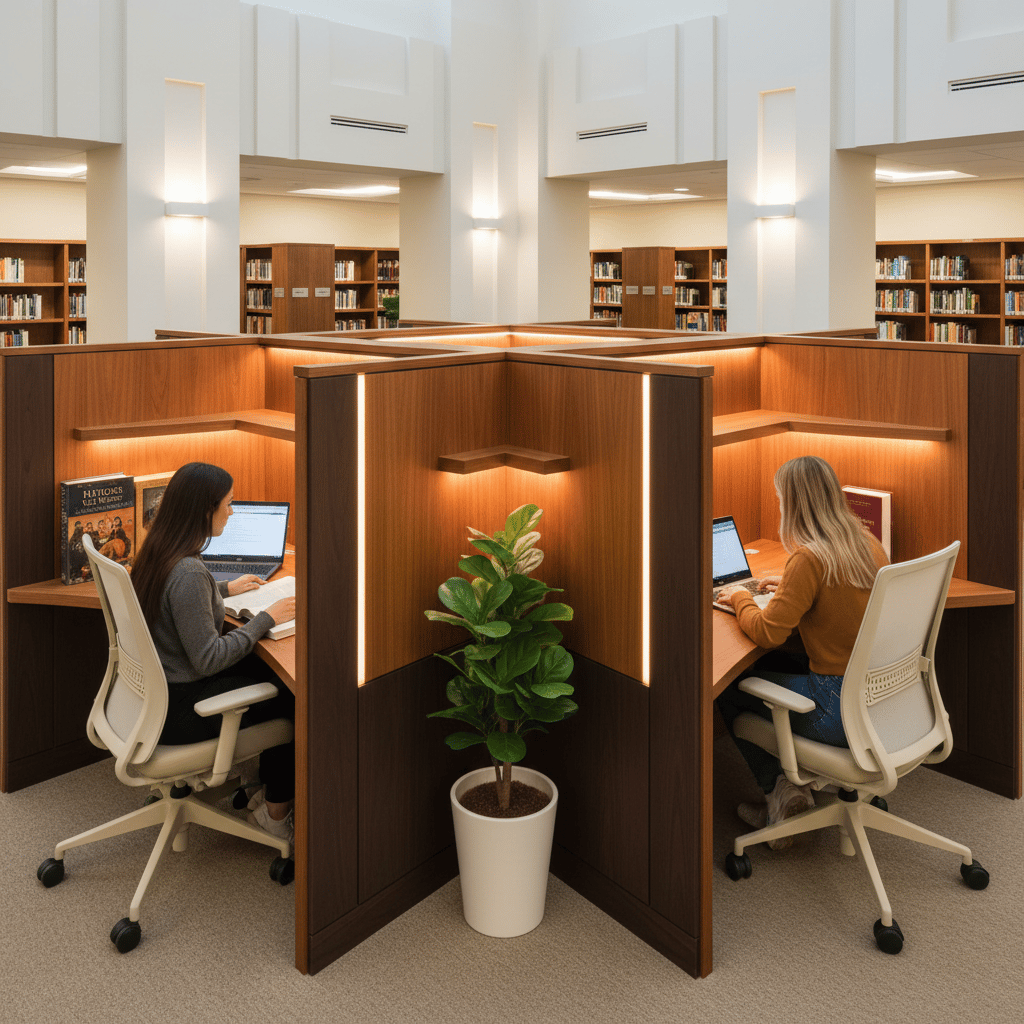
Howard University is going through a transformation of its Undergraduate Library and Founders Library. The objective is to enhance the capabilities of the libraries as learning spaces. Our team has been testing furniture in the library environment to learn about student behavior. The product demos allow our team to test how students will work with the new furniture in the library. It helps the library staff define what types of furniture will transform the environment.

Examples of library collaboration in action including space for individual and group workstations help our team define the requirements for the new design.

Below are pictures of the library design & furniture demo.

No Comments