
Archive for category Social Library Issues

The value of public libraries

The value of public library service is often overlooked by the community. During the development of a capital campaign to improve the library building, it is very important to communicate the value of the library services.

One way to generate knowledge about library services and their cost advantages is to use a calculator. The Chelmsford Library developed one online for you to use. Go to: Library Use Value Calculator

You may use this calculator for survey’s and open discussions with the public. We use this information to learn more about the unique needs of the local culture and the value of the “library as place.” You may use the calculator above to communicate your value and to build an appreciation for all of the services the library provides to your community.

, , , , , ,

No Comments

Evaluation Methods for Library Space

There are complex, complicated and simple library building projects. Our clients typically ask us:

  • How much space do we need?
  • How much does it cost?
  • How long will it take?
  • How many stakeholders should we interview?
  • How satisfied are the stakeholders?
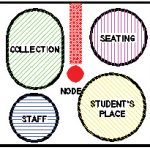
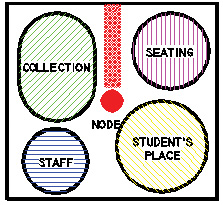
  • ACA’s approach incorporates a quantitative analysis of library services and operations. This is done with a series of survey instruments that capture customer data (visits, temperature, humidity control, # of seats, # of computers, # of staff, type & # of collections). The outcome is a building program of library services including user seating, collection, staff and operations.

    This blog is focused on the Narrative Evaluation of Library Space, Services and Operations.

  • Complex Areas of Research:
      E-resources and E-tools, Curriculum Development, Collection Development.
  • Chaotic Areas of Research:
      Technologies that Transform Learning and Education Environments.
  • Simple Areas of Research:
      ACA’s Best Practices in Library Building Planning.
  • Complicated Areas of Library Research:
      Analysis of Building Designs, Space Plan, Flow and Use of Resources.

, , , ,

No Comments

The Book that Contains all Books

The Kindle is a product that has made history today. It is available globally to anyone who wishes to take advantage of e-book reading technology.

Today’s e-book revolution brings many in the field back to the 15th century. Scrolls were replaced by books and the masses began to become literate. The library of the future will contain e-book readers and it will do its job.

Stephen Marche states in “The Book That Contains All Books. “The introduction of the printing press brought a change to the nature of reading.” Don’t worry it took years for the scrolls to be replaced by the book. We will continue to see the book as a commodity in the art of learning and education.

, ,

No Comments

Changing Libraries – “Readers Wade Into Digital Lending”

The NYtimes article “Libraries and Readers Wade Into Digital Lending,” illustrates that libraries can provide digital services. As a matter of fact, some library patrons are already using the library in new and innovative ways. So, it is not surprising that digital lending is starting to occur in community colleges, academic and public libraries.

Some libraries are ready to make the digital leap so down-loadable e-books is a reality not a possibility. For example, Michael Colford, director of information technology at the Boston Public Library, stated “People still think of libraries as old dusty books on shelves, and it’s a perception we’re always trying to fight,” “If we don’t provide this material for them, they are just going to stop using the library altogether.”

, ,

No Comments

Library as Place – Disney is moving toward a better retail place.

Disney’s Retail Plan is a Theme Park in its Stores, is another example of retailers recognizing the need to create a place. They hired Steve Job’s retailing team at Apple to help them develop interactive learning spaces.

The ‘Library as Place’ is an important aspect of the new service/space paradigm. For example, “the world does not need another place to sell Disney merchandise – this only works if it’s an experience,” said Jim Fielding, president of Disney Stores Worldwide.” In relation to Library Space Planning, people want space to interact with the library material and they need additional types of working environments to do it in.

The ‘Library as Place’ is an important factor in the way we interact with information. For example, by using RFID librarians can equip packages to respond when the customer passes the interactive display. In the future Disney Stores, “Computer chips embedded in packaging will activate hidden features. Walk by a “magic mirror” while holding a Princess tiara, for instance, and Cinderella might appear and say something to you.” – Barnes, Brooks, “Disney’s Retail Plan Is a Theme Park in Its Stores,” NYTimes, Oct. 13, 2009.

mik11

, ,

No Comments

The future of libraries with or without books – CNN

The future of libraries gets the attention of the large networks once in a while. What is interesting about “The future of libraries with or without books” – CNN article is that futuristic concepts of library services are possible.

RFID is an interesting topic. The article explores the Danish concept of extending book information via RFID technology. The set up provides children with an interactive story via an RFID tag-enabled book. A child picks up the phone and a book and hears about the contents.

We recently explored ways that RFID books can be checked onto a “just returned” shelf instead of a counter. This simple process puts the books in a location that quickly returns it to the customer.

Library as Place
Libraries are community places. The CNN article points out that funding is tight in America and that over 16,000 public libraries are facing cuts in funding. We have to be wary of Politicians who don’t use the library. Many perceive that information is online so, why should you have a library?

Librarians can work to make their community forward-thinking. They have to show that demand for the “library as place” is vital to many who use the library to read and access the internet. For example, in Mohave County we developed a program for Bullhead City, AZ. The library was a safe haven for youngsters and a life-long learning center for the seniors. Additional reader seats reduced the crime (got the kids off the street) and adults had space for job seeking and resume writing.

Our message for CNN is don’t give up on our libraries they are part of a healthy America and informed world.

No Comments

This could be the year of e-textbooks – how does this affect library design?

A recent article in the Chronicle of Higher Education about the progress of E-Textbooks states that CourseSmart now offers up to 7,150 titles. According to the article that’s over half of the most popular textbook titles.

Library buildings need to incorporate new types of learning spaces into their design for it to meet a 20 year planning goal. The reality that we are living in a blended learning environment that continues to require more spaces for electronic learning. Indeed, the article states that “the increased awareness and availability of e-textbooks could make this a watershed year for the format-which has held only 2% to 3% of the market until now, according to the National Association of College Stores.”

Our mission is to make sure library buildings are equipped with enough spaces to support “e-learning.” The identification of new library technology is important for space planning, circulation, zoning, access, social and educational progress.

No Comments

Update on Google Books

We have been watching the google book settlement. If you are interested in the case, go to the Inside Higher Ed article – “Life in a Google Book Search World.”

, ,

No Comments

Go to Library School – 100% Distance Learning Opportunities

We believe its very important for librarians to have an MLS degree. There are a number of Graduate Schools that offer 100% online MLS degrees.  It is a great way to become a librarian. 

The following is a short list from the ALA database.

Check it out.
1. Clarion University of Pennsylvania

2. Drexel University

3. Wayne State University

4. North Carolina Central University

5. Rutgers, The State University of New Jersey

6. San Jose State University

7. Southern Connecticut State University

8. Texas Woman’s University

9. University of Alabama

10. University of Puerto Rico

11. University of Wisconsin – Milwaukee

12. University of Tennessee

13.  University of Southern Mississippi

14.  Florida State University

Links to MLS education

No Comments

Google Book Settlement

The Google project is very important to the transformation of library space from a mainly print model to a “blended model” – one that incorporates digital technology as well as print materials into its design. 

The idea that you could access millions of published volumes from a computer in the library is not a futuristic notion. It is already happening in a smaller and less structured format.  Indeed, Google’s on-going legal battles may enable more materials to be available to library patrons.   The question is – what cost?

In order to keep up to date Google’s settlement, you can click and link to a blog dedicated the issues.  The site gives you a list of the latest articles and research on the Google settlement.

No Comments