
Posts Tagged library planning
Education is Changing – Libraries Enhance Learning Support
Posted by acohen in Library Planning Research, work in progress on May 9th, 2013
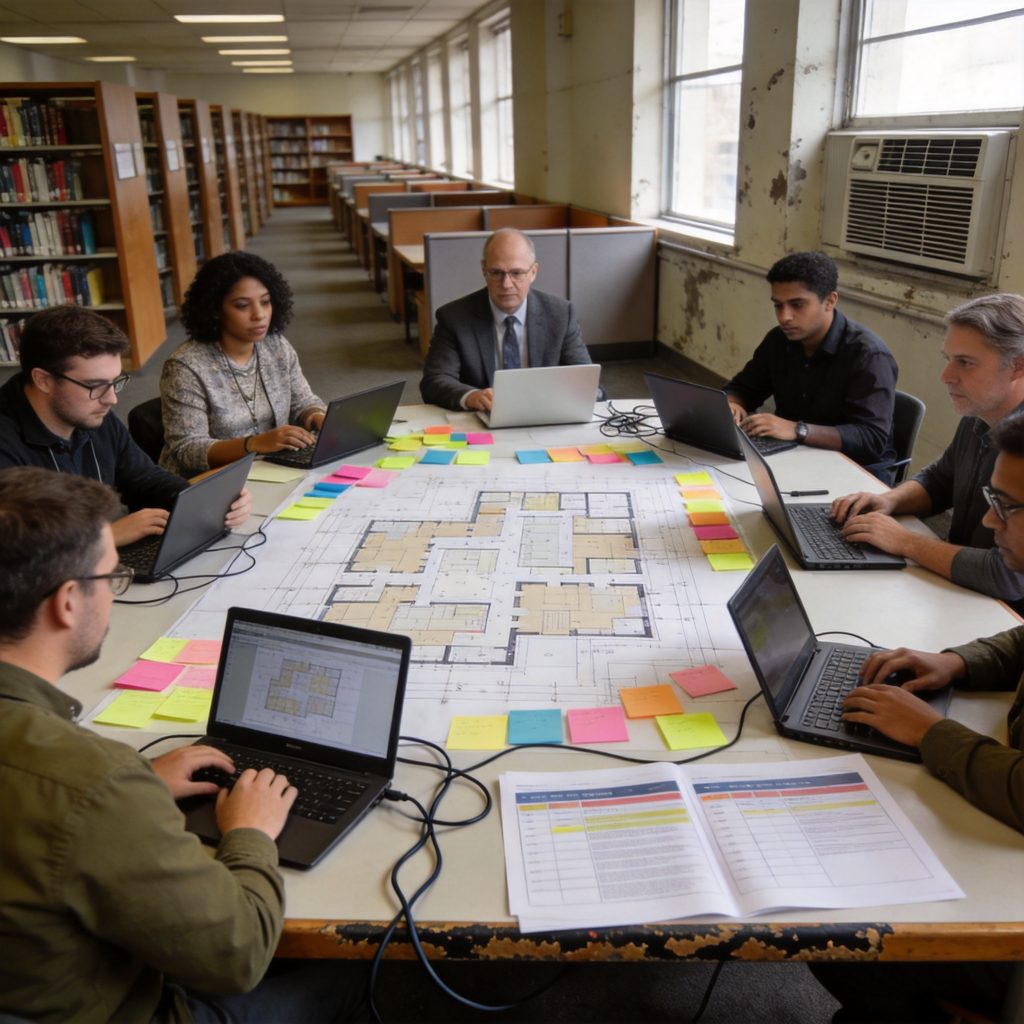
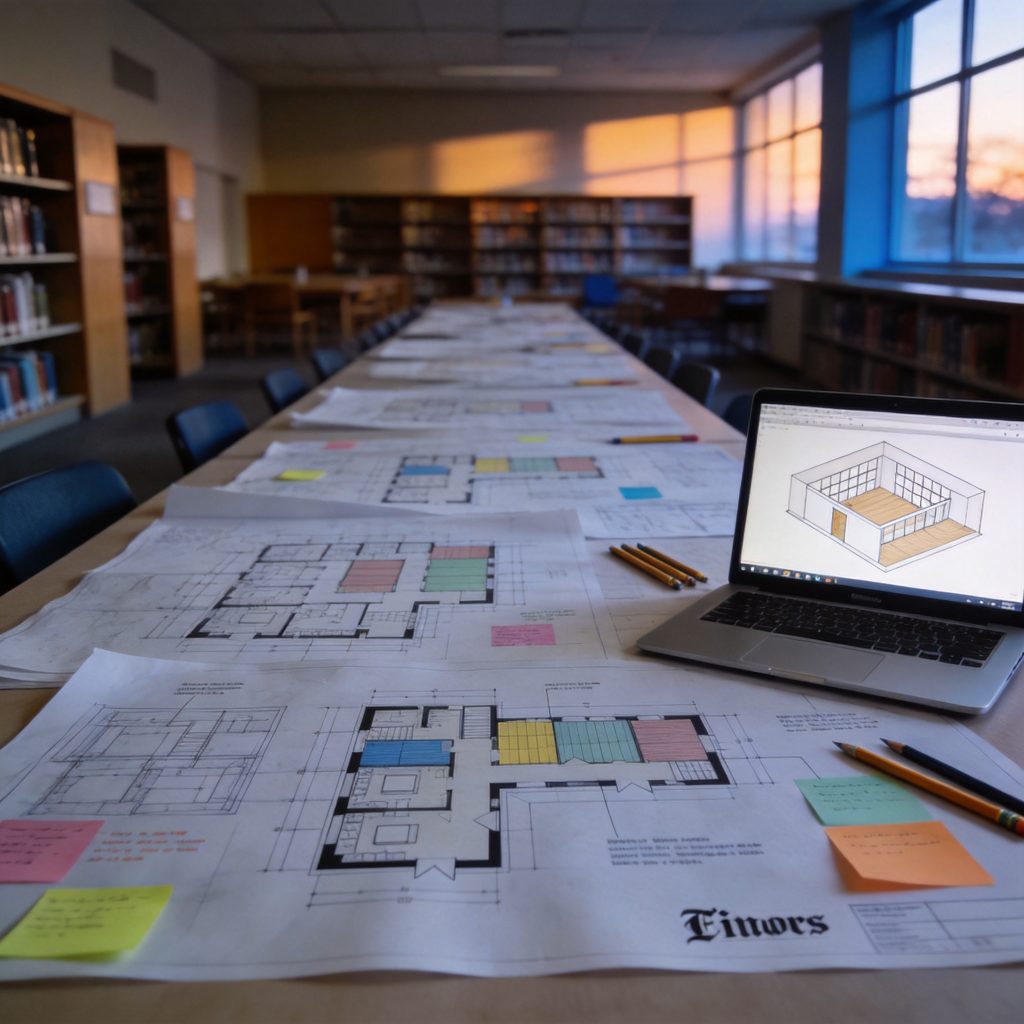
Library buildings can be designed to enhance learning support and research. Librarians can support the workflow of their researchers by directly supporting, managing and aggregating the content. These days there are plenty of librarians preaching community, but what about how we can design libraries to enhance the digital world?
Libraries are places where solutions are possible through access to knowledge and higher education. Planning learning environments requires us to be aware of new opportunities in education technology, open-source software or open-access publishing.
According to “Open Online Courses – an avalanche that might just get stopped“- In the US, the growing chorus for online education through massive open online courses, or moocs, has been deafening.” For example, the California legislature created a bill for the “New University of California” – one that offered no instruction but would issue credentials to people merely for passing exams. Does this model assure that our students are learning in the online world?
The New University of California bill did not pass, but California lawmakers detailed a plan on May 8, 2013 to require the state’s 145 public colleges and universities to grant credit for low-cost online courses offered by outside groups, including classes offered by for-profit companies.
The bottom line is that there really is no replacement for face-to-face interaction between teachers, professors, librarians and students. Digital and online methods can enrich those interactions, but it is no match for the community of services at our Universities and Colleges provide; the community of professors, tutors, peer mentors, librarians, IT help, libraries, computers labs, disability services and academic support.
It seems unlikely that libraries and learning spaces can be replaced by online learning without considerable investment in electronic resources. No wonder 72% of those who have taught moocs over the past three years believe students who took their classes had not done sufficient work to deserve credit from their institution.
Libraries and Learning Commons can be created with clusters of valuable and distinctive services. Librarians can ensure that the learning environment, enhances the reputation of the community, faculty and the institution. Librarians will continue to ask – What services does the community need? How can their output be preserved, discovered and re-used?
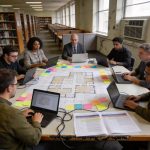
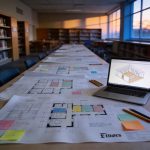
You can think of the Learning Commons as an incubator. It is an “I-Lab” – a multifunctional and fluid space for learning. The photo below is a visualization board that is at the Mathematics Museum in New York. It is an example of a physical environment that will support online learning technologies.
As Search Goes Mobile, Apps Change the Way We Use the Library
Posted by acohen in Library Planning Research, Social Library Issues, work in progress on April 5th, 2013
A couple of months ago, it seamed like all of the library information systems – ILS vendors were developing apps. The business of finding information had gone mobile; everyone was trying to develop a way to reach their customer more effectively. The New York Times article “As Search Goes Mobile, Apps Chip at Google’s Lead” discussed how searching for information is mobile. It states that Google is under pressure to change, because the behavior of searching for information is changing.
Entering the library to find answers is going to be a lot more mobile for users. The mobile user will search for information in different types of environments. Shar VanBoskirk stated “there is a lot of pressure on search engines to delivery more customize, more relevant results. Users don’t need links to web pages. We need answers, solutions, whatever intel we were searching for.”
We like to visualize and think about Apps as virtual “touch points” for content; providing new opportunities to find information. The mobile App can be combined with a physical “touch point” in and around a campus or in a community library.
A synergy of positive feedback can be created in the library to enhance learning activities. Libraries act as connectors for social and public spaces. They can be flexible “research commons” – places with an enhanced wireless network, lighting controls, heating and cooling and flexible furniture.
Learning with Technology
Posted by acohen in Library Planning Research, Social Library Issues on March 19th, 2013
The most visible signs of our embrace of digital media belongs to the students – young and old. The way they learn using computers, iPads, e-readers and smartphones are different than the past. They are quick to embrace the “library in the cloud” as Sugata Mitra describes in Build a School in the Cloud. It is natural for them to work in groups to learn. With just a little support from a “grandma” or someone who is older that encourages them as Mitra points out, the students can learn anything from a device connected to the net.
The shift taking place in libraries is proving to be transformative in the ways we use information. It is not only Community Colleges and Universities that are being transformed, but as the Strategic Content Alliance stated in Sustaining Our Digital Future: Institutional Strategies for Digital Content – “The use of dynamic digital resources — websites, digital collections, databases of crowdsourced or born digital content pose opportunities and challenges that are all their own.”
Our universities are working to understand the impact of globalization on higher education in an increasingly transformed environment. This ranges from overseas universities offering cheaper undergraduate and graduate programs to the development of “massive open online courses”, or MOOC’s.”
It has become clear that a great deal of the content that libraries are holding today is expected to endure because of our natural embrace of technology. We need to start rethinking how libraries and learning centers can support this paradigm shift in the 21st century.
NYPL Library Planning – looking toward the future..
Posted by acohen in Library Planning Research, Space Planning, work in progress on February 4th, 2013
The NYPL is a unique library institution with a historical research component as well as a public center of culture in New York. Over the years, the public library has evolved into a “culture house” – a place for community gathering, electronic collaboration and cultural programming/events. However, digital projects live everywhere! This extreme decentralization of library and information services adversely affects the value of the library building i.e. when it looses touch with the strategy the building was designed to support.
In Renderings for a Library Landmark, Stacks of Questions, Norman Fosters design for the renovation of Manhattan’s 42nd Street branch of the New York Public Library is taking a bad rap. In this age of the Internet and e-books, libraries must change if they are to survive. No one wants to support an institution that does not offer collaborative space, research services and facilities to enhance culture – in this case New York City, the Big Apple and the Melting Pot.
Although they were once important aspects of New York Public Library’s organization, the time has passed for the Mid-Manhattan and Business Libraries. Library services and culture has changed; so the design strategy must change. We say this even though Aaron Cohen, AIA and Elaine Cohen, Ed were once authors of an architectural program for a major expansion of the Mid-Manhattan Library and on the team that evaluated the pros and cons of the storage facility under Bryant Park before it was constructed.
Below are examples of Norman Fosters work – the Boston Museum of Fine Arts. It is an example of the grand space Norman Foster will design to enhance the 42nd street library.
The library planning equation and the NYPL example – The library of the future is part Bookstore, MakerSpace and Culture House
Posted by acohen in Library Planning Research, Space Planning on December 27th, 2012
The Library is still defined as a place that holds knowledge. We noted today that books are still part of the library planning equation. According to Libraries See Opening as Bookstores Close – NY Times December 27th article by KAREN ANN CULLOTTA – “As librarians across the nation struggle with the task of redefining their roles and responsibilities in a digital age, many public libraries are seeing an opportunity to fill the void created by the loss of traditional bookstores.”
The library will always be a space with books, knowledge resources (librarians), training, programs and quiet reading spaces. However, the spaces being allocated to books are being redefined, which makes our work challenging.
Books are still and will always be a knowledge tool of choice for many people. We recognize this fact as we plan tomorrows library collections. We also plan that libraries will be MakerSpaces and Culture Houses and Bookstores of the future. These strategies will continue to be priorities in our planning for 2013.
The ‘library is a place’ that should offer culture, knowledge tools and space to use for digital bits and physical atoms. Indeed, it will need to support all options for research.
The new library plan for the NYPL is a very exciting concept with new space designed for learning activities. The big challenge for the NYPL is to create a blended learning environment, not just a vast open room full of computers, but also spaces with books, media and historical resources. Flexible areas with movable partitions and bookstacks with books to check out need to be integrated into Foster’s plan.
Click on the link below – it is an impressive flyover of the new library planned for NYPL by Norman Foster…
NYPL – Library Plan
Boutique Zones in Libraries Create Desintations for Learning
Posted by acohen in Library Planning Research, Space Planning, work in progress on October 3rd, 2012
A recent article about JC Penny’s transformation into a series of boutiques is noteworthy to library consultants, librarians and architects. The former Apple retail chief Ron Johnson is trying to transform the physical space plan at JC Penny. He is changing the JC Penny retail environment into a series of focal points – boutique spaces that attract more involvement with the brands and the customers. This creates new opportunities for interactions with the product(s).
JC Penny’s intends to RFID all the items in the store, creating opportunities for mobile retail environments. The idea is to create different boutiques that can be transformed annually in an efficient way, leveraging RFID’s advantage as an accurate way to keep track of your products.
The use of RFID as a way to keep the product in a system that is mobile in nature is intriguing. RFID allows management to move or change the location of the product to any part of the store at anytime during the year. For example, Christmas requires a change to the environment to reflect the holiday spirit. Johnson’s strategy is to enable the store manager to redesign the space efficiently without doing an inventory each time it occurs.
PC Penny’s plans remind us that the RFID chip can be used to create a flexible “library as place”, keeping inventory control in an orderly manner and adapting to the needs of the community on an quarterly or annual basis. The strategy enables the library to be changed without a large redesign investment i.e. knowing where each book is placed gives the library staff an opportunity to move the collection around without being concerned about inventory control.
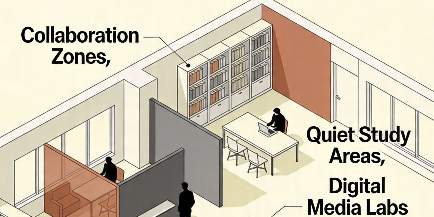
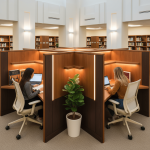
A flexible library environment is more vital today than ever before, because spaces for quiet study, collaboration and computer access are increasingly filled with patrons in need of workspace. Indeed, patrons are using the library’s environment more and more to excel in research. They are using the library for group meetings and any number of activities. However, the library buildings are limited by inflexible designs of the past – static books, lots of walls, poor inventory control and fixed furniture.
To truly create the learning environment that is needed today, librarians and educators need to think of ways to create flexible spaces on a quarterly or annual basis. For example the seating areas for quiet study don’t need to change often, but the group spaces and program areas need to be flexible for different sizes of groups. They need to be flexible for different modes of learning on a continual basis. Libraries that don’t have these types of building programs become static and inefficient.
The library needs strategies to support the “endless demand for quiet spaces” and the “endless demand for group activities.” The boutique zones strategy by Ron Johnson at JC Penny, creates new opportunities to manage the stock (inventory) in an efficient way, creating a retail environment that will be in constant motion. This long term strategy looks promising for libraries that start to harness a flexible building program and design. If they already have RFID, they can use this technology to develop flexible zones in their building; programs that leverage mobile technology to keep the library space in constant motion.
library reference desk – library service desk
Posted by acohen in Library Planning Research on June 12th, 2012
The library is an important social place. The experience of sharing and communicating in a learning space is vital to the development of effective schools, public libraries and academic institutions. In a recent analysis of the library service desk, University of New South Wales (UNSW) Library Planning Team presented a case study on the library reference desk. They explored the idea of no reference desk.
Since all libraries are different, it is important to develop a strategy as well as make some tactical service planning decisions. A change to the service environment should be taken with careful planning and understanding. The entire team should be included in the development of the concept, creating team-building activities to explore how the library would function without a service desk. Even if the library staff is not ready for this type of service environment, this is an opportunity to explore ways to efficiently and effectively improve library services.
Library Fundraising
Posted by acohen in Library Planning Research, Social Library Issues, work in progress on June 5th, 2012
It is important to connect librarians with resources to be successful. One area that is important for any library project is the development of a program for the activities in the library. However, if the building or organizational program does not have sufficient funds to achieve a good return – the project might not get started at all. For this reason, every librarian should consider fundraising as an opportunity and a challenge.
A good place to learn about fundraising is from some experts.
Library Advocacy – Library Fundraising Resources
Value of Library: the Man in the Google glasses
Posted by acohen in Library Planning Research on April 16th, 2012
The Library provides more than just a books, media and computers. It provides a social space to gather, creating opportunities for people to network their skills and learn from each other. The library delivers opportunities to share in groups, learn from peers and connect with friends. The library is a place that allow for common activities and social connections in a physical environment.
In the future, work and study will be more electronic. Students will do most of their work in the “cloud;” most faculty will be teaching and testing 100% online. From a library technology point of view, mobile tools, multi-platform visualizations and 3D printing will be available for collaboration and high-speed communication.
Google Glasses are a good example of how the world will change 10 years in the future. In the future, we will be pulling up content from our glasses in new and different ways, reacting to our environment with library search technology. The OPAC or library catalog will be available on the go.
In the op-ed “the Man With the Google Glasses” by Ross Douthat, we realize that technology is not the only answer to a healthy learning environment. According to a Duke University study, Americans used to have more friends. In the 1980′s Americans reported having, on average, three people with whom they discussed important issues. In the mid-2000′s, Americans became more isolated with only two close friends to share important issues. Is this a result of our use of the internet?
Social Isolation is real. For example, Sociologist Eric Klinenberg, “Going Solo: the Extraordinary Rise and Surprising Appeal of Living Alone.” He states that more American’s are living alone today then ever before, begging the question: what about libraries? Is it the place for positive social interactions in a technological world?
The Library is critical to sharing information when connected virtually or not. It is a place for scholarly, social and cultural uses. It provides opportunities for the Man with the Google Glasses to interact with the community.
For a road map to begin research – go to: “Library start up” – physical and virtual space for social interaction, jobs communication and sharing. Physical or Virtual, it is a quiet and noisy space to grow ideas into a better future world.
Below is a link to a video from Google About their Glasses – note that the protagonists visit’s the Strand Bookstore. Google should have the person meet at the library. It is a better place to gather and share. See -Google Glasses
The Library’s Digital Data and an Ark Full of Books
Posted by acohen in Library Planning Research on April 4th, 2012
As society embraces all forms of digital entertainment, a latter-day Noah is looking the other way. Brewster Kahle, who runs the Internet Archive, a nonprofit, hopes to collect one copy of every book.
Brewster Kahle is trying to make sure the flood of Digital Data does not leave behind important knowledge. According to Kahle, “We must keep the past even as we’re inventing a new future.”
There are librarians who actively collect important documents, books and media. They are people who safeguard culture and history. They are bridge-makers who actively seek and shape their collection.
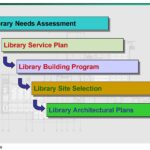
A key aspect of library planning; create a collection development plan that fits your institution and community.