What Storytime Builds
Storytime readings help children’s brains develop the foundational capacities on which all later learning rests: concentration, the ability to focus, imagination, and curiosity. It cultivates social skills, emotional regulation, and perceptual and cognitive abilities. These are not soft outcomes. They are executive and interpretive functions that determine whether child can sit with problem, picture a solution, and stay with the work long enough to finish it.
The mechanism is supported by the public library. Basically, the well-told story explains complex concepts like heroism, adventure, morals, ethics, behavior, and the durable lessons of a life. Yes, storytime spaces provide an environment for young mind to absorb knowledge. The flexible space that the library provides is not abstract; its concrete and its functional. Indeed, we don’t learn just by memorizing a rule. We learn about courage from our community; from storytime examples.
Library as Place
Certainly, the library is a place where the child watches characters be brave and learn from ones that are open to learning. Here at the public library, a child learns to understands what words means. What is a lie and what is possible. This is why storytime space or flexible library space succeeds where fixed learning spaces often fails. The library that delivers difficult content wrapped in a form of a story enables the brain to receive knowledge.
Evidence Beneath the Practice
The case for storytime is no longer intuitive. It is neurological. The claim that shared reading shapes the developing brain traces to a body of research led by John Hutton and colleagues at Cincinnati Children’s Hospital Medical Center, whose work established measurable, quantifiable effects of the home reading environment on children’s brains.
Their foundational 2015 study broke new ground. Although parent-child reading had been shown in behavioral studies to improve oral language and print concepts, quantifiable effects on the brain had not previously been studied. Indeed, the study used blood oxygen level or dependent functional magnetic resonance imaging to examine the relationship between home reading environment and brain activity during story listening task. The finding was direct and its consequential for libraries. For example, in preschool children when they are listening to stories they are getting greater reading exposure. This is positively associated with activation of brain areas supporting mental imagery and narrative comprehension.
The Impact Study
The team extended this work in a 2020 study examining the physical architecture of the brain itself. Hutton, Dudley, Horowitz-Kraus, DeWitt, and Holland published “Associations between literacy environment, brain white matter integrity and cognitive abilities in preschool-age children” in Acta Paediatrica in 2020. The study moved beyond momentary activation to structural development. Storytime reading is advocated by health organisations, citing cognitive and neurobiological benefits. The research connected the literacy environment not only to what the brain does during a story but to how the brain is physically built.
Note, the American Academy of Pediatrics recommends parent-child reading from infancy through at least kindergarten, the span of maximal brain growth. That space in the library is important. Its a gateway to success. Libraries need to support children from infancy through kindergarten. Certainly, the library’s early childhood programming does its most important work when it has flexible space for stories.
Why This Belongs in the Library
Community priorities are library priorities. When the community recognizes that home school readiness, early literacy, or family support is its goals, we think of the library. This research reframes what the school library especially when there is a large and welcoming reading circle. Storytime is filling an hour that mothers and fathers need too. It is delivering, at no cost and open to all, an activity that has well documented neurological effects. During the single most consequential period of human brain development, we need more public library space for stories.
Note: this concept for libraries carries direct implications for how the community allocates its resources.
Space
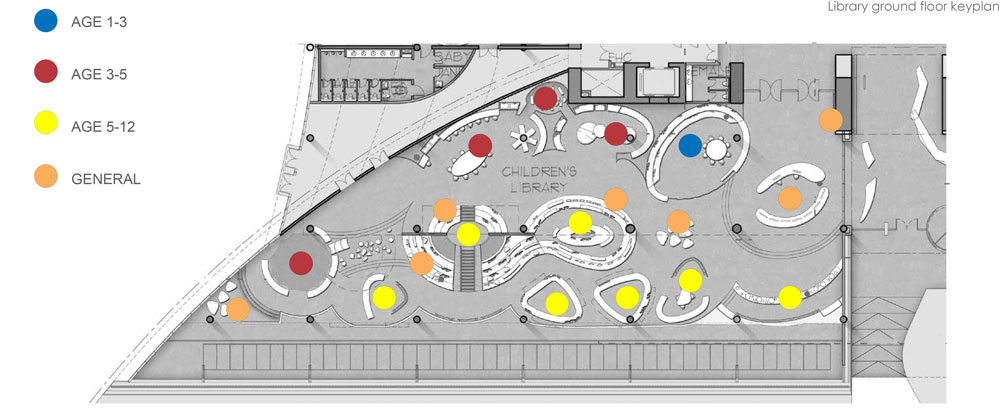
The reading room for early childhood is an inspiring place. It is the delivery point for core literacy services, and it should be planned as one. The library must support the two conditions the research identifies as active ingredients: sustained attention and shared engagement between librarian and child. That means acoustic separation from high-traffic zones, sightlines that let a caregiver and child settle without distraction, and seating that accommodates an adult/parent and children together. Note, the proximity to library collections that feed the practice; inspiring reading is key. The layout should be welcoming rather than institutional, and it should be evaluated against the highest standard.
Collection
Library is a literacy environment, including spaces that encourage reading behaviors and access to books. It has been shown that library programs promote oral language and reading concepts. Indeed, access to books is part of the outcome and it is part of the mechanism of a successful public library.
Collection development for early childhood is a very important functions of a public library. It is a developmental strategy, and not merely an acquisition exercise. The picture books, board books, and read-aloud titles that inspire reading is key. Certainly, the storytime room and adjacent bookshelves are the raw literacy materials. The selection deserves the same rigor applied to any collection central to the public libraries institution’s mission.
Staff
Storytime is a skilled activity and it takes practices. Our research on shared reading zones shows that the space matters. It helps the children engage with the content; how a story is read and the environment around it shapes the developmental effect. This means that the staff who lead these sessions require genuine engagement environment.
Defining library priorities means asking the public – do we have the right space to enhance literacy? And of course, staff need to be part of this process. They spent time supporting literacy. And the evidence argues that time spent developing and delivering strong early literacy programming is among the highest-return uses of staff capacity that the library commands.
The Priority
Developing for the future? The library needs assessment measures condition, age, size, access, and use. It asks whether the library is supporting its service priorities and whether existing facilities are configured to deliver them. Here, storytime space should be considered. We provide an analytical framework for developing next generation libraries. We design and develop space that is adaptable. This is a library service whose value is now documented in the developing brain itself.
Library leadership that understands the value of story telling plans differently. It treats the early childhood activities as core infrastructure. It funds programs that connect with the collection. The library space feeds curiosity, and staffs the program with people who know how to read a story well. The research has closed the distance between what library feels it is doing for children and what it is measurably doing to their capacity to learn. Think about how a story read aloud in a public reading room activates the regions of a child’s brain. Think about how spaces govern imagination and comprehension. It may take years to support the next generation and few services a library provides can make that claim. None deserves more deliberate planning than the development of story telling and story time in the library.