
Five Disciplines for Research Professionals
Space is one of the most expensive assets in a research library. It is also one of the least understood. Space can be physical collections and also digital ones. Libraries run on space (print and digital). Research professionals need to be knowledgeable about reshaping strategies to support collection growth and development.
Libraries do not buy space by adding shelves. They create services by understanding its collections, its users, its service obligations, and its operating constraints. The library needs space by confronting general problems like “we are running out of room.” Basically, you need to organize your collection and service planning into a set of measurable decisions about capacity, access, preservation, staffing, technology, phasing, and cost.
The central question is not how many books fit in a room. The central question is what kind of repository the institution needs: physical, digital, or both; public, restricted, or hybrid; static storage or active research infrastructure.
That question requires discipline. It requires numbers. It requires a plan.
1. Develop a Catalog of the Content Your Library Owns
The first step in design is knowing what the library contains.
For example, a research collection is not an undifferentiated mass of boxes, books, archive notess, scans, emails, notes, images, videos, and resource files. Each content category has its own spatial, technical, and service requirements. Think about how heavy a bound volume is and how it is moved differently from manuscript in a box. Indeed, the digital image collection behaves differently from an email archive, and a rare book requires different environmental standards. Note, film and photographs require cold access conditions than a current-use monograph needs.
Classification is therefore not merely bibliographic. It is architectural, reshaped for the next generation users.
Certainly, the Dewey Decimal Classification, Library of Congress Classification, and local technical services methods provide traditional ways to understand the intellectual features of a collection. They also provide ways to understand the physical behavior of the collection. The payoff is subject concentration, format, size, frequency of use, and relationship to research programs. Collections can influence everything from where materials belong to how they should be accessed.
The current generation of catalogs are integrated with Discovery systems. These systems are more than titles and call numbers. The Discovery system has tools to identify the nature of the holdings, their formats, their dimensions, their growth patterns. However, few have integrated collection relationship to current and future research activity, because that is unique to each research institution. For example, when we distinguish general holdings from special collections we are also talking about uniqueness and value to current research. Basically, we need to study how active-use materials are retained for future access use. When you think about how you identify materials, you also need to think about the environmental controls, restricted access, or specialized handling. This is what we call the library operations plan or workflow analysis.
Without this discipline, every square foot is treated as equal. In a research library, square feet are never equal.
2. Right-Size the Physical and Digital Repository
The second discipline is right-sizing. In the digital world we call it scaling, but its really another way of looking at right-sizing for the future.
Our research of library repositories architecture is that closed stacks are hard to manage without an ARS system. The library is not a warehouse. It is a service platform. Its physical and digital services must be sized according to how the collection is used, how it is accessed, and how the institution intends to support research over time.
From library architecture and space planning, physical storage requires attention to shelving type, tray size, stack configuration, retrieval process, staff workflow, and user access. From an IT and Digital Asset Management world, digital storage requires attention to hosting, backups, archiving, localization, discovery, preservation, file management, and information technology support. The two repositories can be planned separately on two different “train” tracks, but they will need to be coordinated into a master plan. Note: Scans, emails, notes, resource files, images, videos, and born-digital materials all create library space requirements, even when they do not occupy shelves.
Right-sizing begins with scenarios and storage models. The library must define modes of access: open browsing, mediated retrieval, restricted reading room use, digital delivery, or a combination of these. Each mode has a cost. Each mode has an architectural consequence. Each mode has a staffing consequence.
The goal is not maximum storage. The goal is the correct relationship between access and storage.
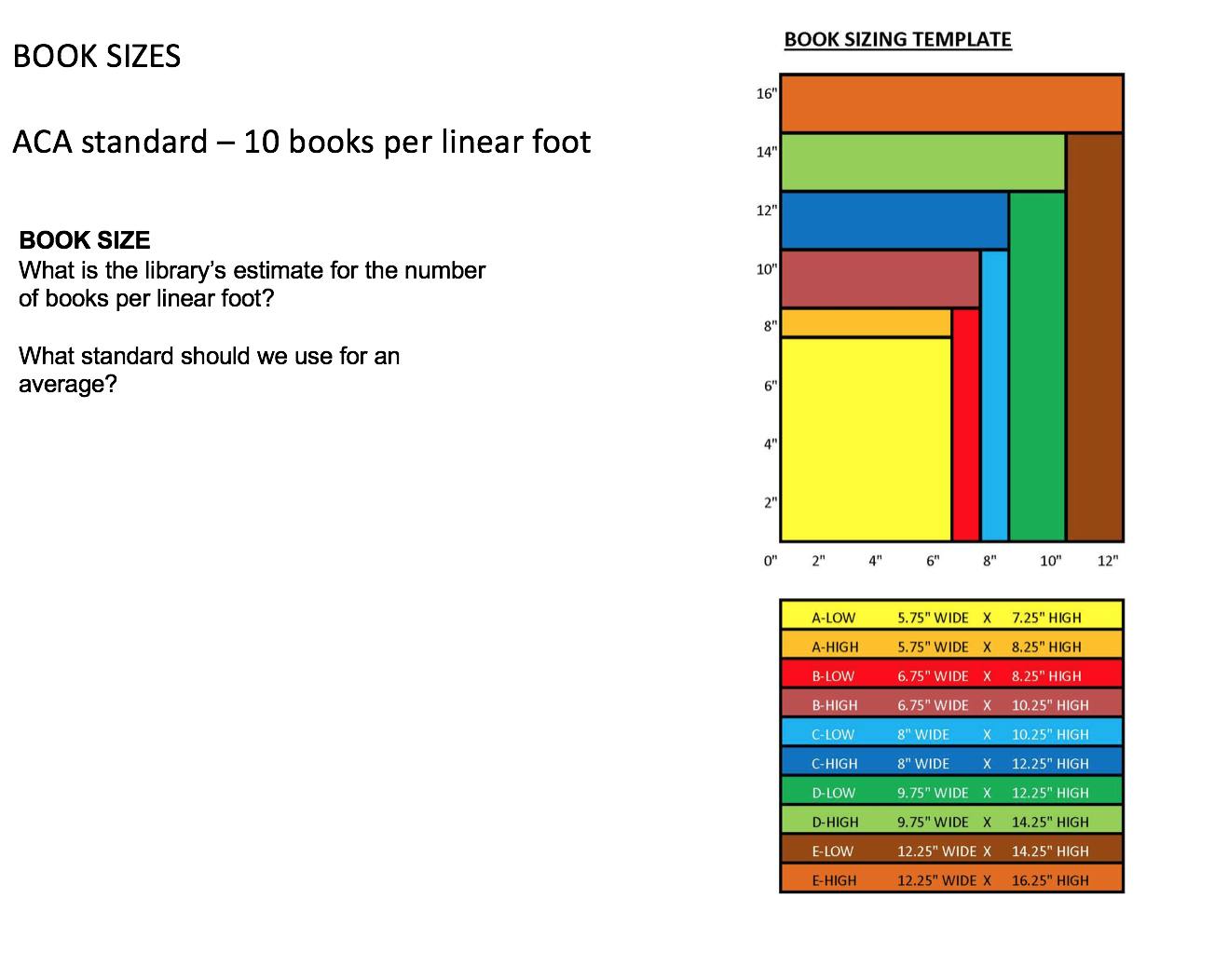
During a project for NIST, we analyzed a high-density storage systems. Here, we wanted to make sure the government could increase box capacity dramatically, but only when the collection profile fit into the right system that was build for access and storage. For example, one vendor calculation illustrated the importance of precision. They noted a 40-foot-high unit using “B” size book trays produced the following capacity model:
– 24 book trays per pan
– 1.5 linear feet per book tray
– 36 linear feet per pan
– 67 pans per unit
– 2,412 total linear feet
– 20 books per linear foot
– 48,240 books total capacity
A 50-foot-high unit, using the same assumptions, increased capacity:
– 24 book trays per pan
– 1.5 linear feet per book tray
– 36 linear feet per pan
– 85 pans per unit
– 3,060 total linear feet
– 20 books per linear foot
– 61,200 books total capacity
The difference is that we were analyzing storge in cubic feet. So, ten additional feet of unit height produced 18 additional pans, 648 additional linear feet, and 12,960 additional books under the stated assumptions.
That is how we develop storage for research purposes: by translating height, width, depth, tray size, collection dimensions, and books per linear foot into capacity.
3. Test the Assumptions Through Pilot Project
The collection model is a hypothesis until it is tested. The storage requirements are tested to understand the options.
The third discipline is the pilot project. For example, our government library pilot project determined logistics before capital was committed. It tested whether the proposed storage configuration fit-in with the actual collection. It tested whether researchers or library staff could retrieve materials efficiently and safely. It tested whether user access patterns supported the proposed service model. It tested whether the digital access points were integrated so the researcher could see digital scans, emails, notes, resource files, images, and videos as part of the discovery layer.
Pilot work is especially important when considering automated or high-density storage systems such as an ARS or Lean-Lift configuration, or when reconfiguring conventional shelving. The promise of density must be measured against handling requirements, retrieval time, item size, tray fit, collection sequence, and staff workflow.
For example, tray size demonstrates the point. One of our storage system tests for an international university library offered multiple tray profiles:
– **A-tray:** 6 inches tall, 6 inches wide, 18 inches deep
– **B-tray:** 7.5 inches tall, 7.5 inches wide, 18 inches deep
– **C-tray:** 8.5 inches tall, 8.5 inches wide, 18 inches deep
– **D-tray:** 10.5 inches tall, 10.5 inches wide, 18 inches deep
– **E-tray:** 13 inches tall, 13 inches wide, 12 inches deep, fitting three deep on each shelf while the others fit two deep
These dimensions are useful and helpful in understanding how to store by size and leverage tray sizes to develop collections. They define what can be stored, how densely it can be stored, and what compromises the library accepts.
In one calculation, we tested a unit with 54 pans, each pan measured 96 inches wide by 41 inches deep. It was modeled using “D” size book trays only. Each pan held 18 trays. Each tray supplied 1.5 linear feet. The result was 27 linear feet per pan and 1,458 total linear feet. Note, we use 10 books per linear foot, so the unit held approximately 14,580 books.
That capacity applied to books no higher than 13 inches and no wider than 10.5 inches. If the dimensional assumptions changed, the capacity changed. So, less conservative model s can be produced. We tested 18,090 books for materials no larger than 10.43 inches high by 10.5 inches wide. This was a shift to “B” trays producing potential capacity of 24,120 books.
The lesson is do the math and develop scenarios for the future. The library does not gain space or expand services by only selecting equipment. It gains by matching research needs to support the realities of the collection.
4. Develop Master Library Plan
When we support pilot research library project leaders, we produce evidence on what is and what is possible. Basically, our master library plans convert that evidence into institutional action or strategic service planning reports.
Yes, the fourth discipline is master planning; taking the time with a strong methodology to build an outcomes based future. For example, a master library plan establishes the phasing, scheduling, resource allocation, budget framework, financing strategy, fundraising opportunities, grantmaking path, and service priorities. It outlines the requirements to implement repository access strategy over multiple years.
This plan should include both physical and digital collections acquisitions. It recognizes that the physical library, and the digital library have many of the same institutional issues; resources, staff time, systems support, capital investment, preservation planning, and user education.
The library master plan does not list projects to be done. Through our methodology we sequences the decisions and timelines.
We identify what must happen first, what can run in parallel, and what depends on prior work. We analyze implementation tasks against reality assumptions. We assigns resource needs and plan for new ones.
We establishes budgets and financial responsibilities. We creates a framework for pooling resources across departments and leveraging the in-house team. We supports parallel evaluations so that shelving, storage systems, digital archiving, service planning, and technology support do not proceed in isolation.
The plan must also translate organizational goals into physical space. A research library exists to support inquiry. Its master plan must define how collections, access points, service desks, reading areas, restricted storage, digital platforms, and staff workspaces support that purpose.
Library planning without phasing is a wish list with no funding. A plan without resource allocation is a statement of interest. A plan without service priorities is construction without strategy.
5. Sell the Idea Through Library Service Plan
Research Library projects fail when they are presented only as facilities projects.
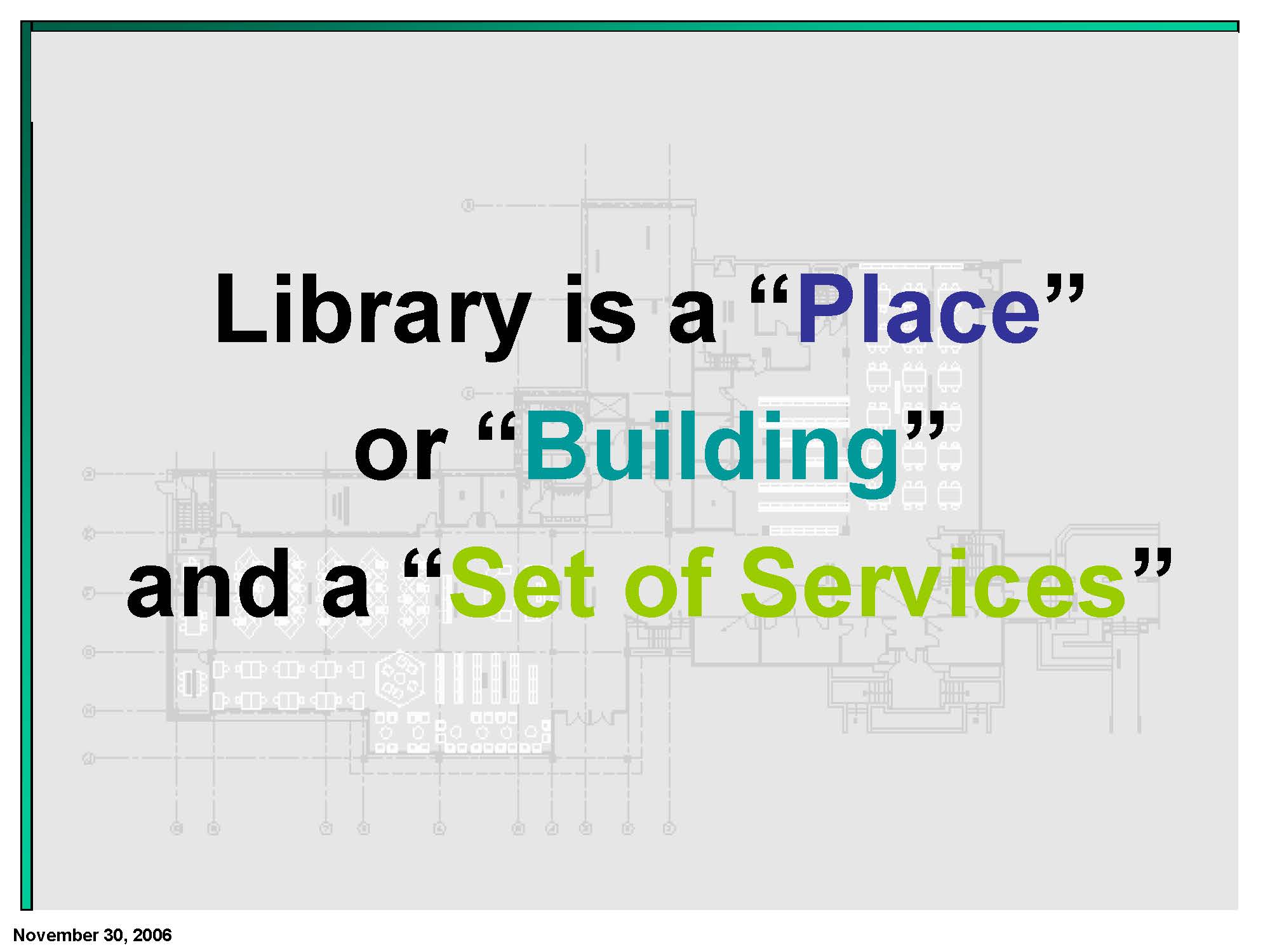
The fifth discipline is the library service plan. This is the document that connects repository decisions to institutional value and solid outcomes. It explains why the library research collection is needed, how the collection will be used, what services will be provided, what technologies are required, and what time and funds required.
The service plan addresses the physical and digital programming needs. It defines user behavior and/or functional service planning for the repository. Basically, we focus on actual and potential collection usage, user behavior, access expectations, staff capabilities, operations, overlaps, and quantifiable outcomes. The user need requirements are a part of this puzzle.
The case for communal learning is strongest when it is grounded in use. How do researchers discover materials? How do they request them? How quickly must they receive them? Which materials require mediated access? Which materials can be digitized? Which digital collections require local support? Which services overlap? Which capabilities already exist inside the institution? Which capabilities must be built?
This is the library service plans language. It helps with institutional decision-making, moving things forward. It supports the future including square footage and digital access outcomes.
Our library service plans also give administrators, funders, and internal stakeholders strategies to communicate the repository as a strategic asset. It shows how research investment in storage, access, digital infrastructure, and staffing supports the research mission. It turns library facilities requirement into increased collectives of service outcomes.

This is a Management Decision
The research library develops access when we learn how to manage its collections as assets.
Basically, our work begins with a vision, a mission and strategies to maximize our investments. Our work continues through right-sized physical and digital collaboration centers with local repositories, tested assumptions, disciplined pilot projects, master planning, and service-based advocacy incorporated. It requires knowledge about library service measurements, and clear priorities that can be translated into outcomes. It requires attention to collection needs; digital access, books per linear foot, tray dimensions, pan counts, unit height, digital archiving needs, staff workflow, and user behavior.
The research team that understands these relationships doesn’t have to justify their existence. We help defines the capacity it needs, the services it will deliver, the resources required, and the sequence of implementation.
Collections are not just perpetual. They are planned. High density virtual storage is measured. Digital service / access service workflows are justified. When we engage in the development of a repository that support researchers, it is created with confidence.