


Collection development is not an acquisition strategy. It is an institutional and organizational commitment. We provide disciplined process aligning what a library holds (capacity to hold) with what its community needs: Now, 18 months, 1-3 years, and 5-10 years ahead. Libraries that treat collection development as a purchasing function misunderstand the opportunities for engagement. Libraries that embed collection development in their strategic planning and infrastructure turn it into a competitive advantage.
Collection development matters because the pressures on library funding have never been more important. Physical holding changes provide opportunities for print renewal and a digital futures spaces. Primary sources / special collections demand new space planning and storage strategies. This planning work is reshaping how researchers discover and interact with materials. The gap between what we know about our collections and what our community believes is a challenge. Closing that gap is a library service planning problem as much as a storage and shelving one.
What Collection Development Actually Means
The Society of American Archivists and the Association of College and Research Libraries define primary sources as “materials in a variety of formats that serve as original evidence documenting a time period, an event, a work, people, or idea.” Collection development is the ongoing process of deciding which such materials an institution acquires, retains, digitizes, deaccessions, or makes accessible — and on what terms. That definition encompasses far more than selection – it implies that we need to understand the space as well as the collections.
From our perspective, this work includes an understanding of the spaces, allocation of resources, acquisition strategies, donor relations, deaccessioning requirements, preservation requirements, master library planning, and the alignment of collection storage with the institutional mission.
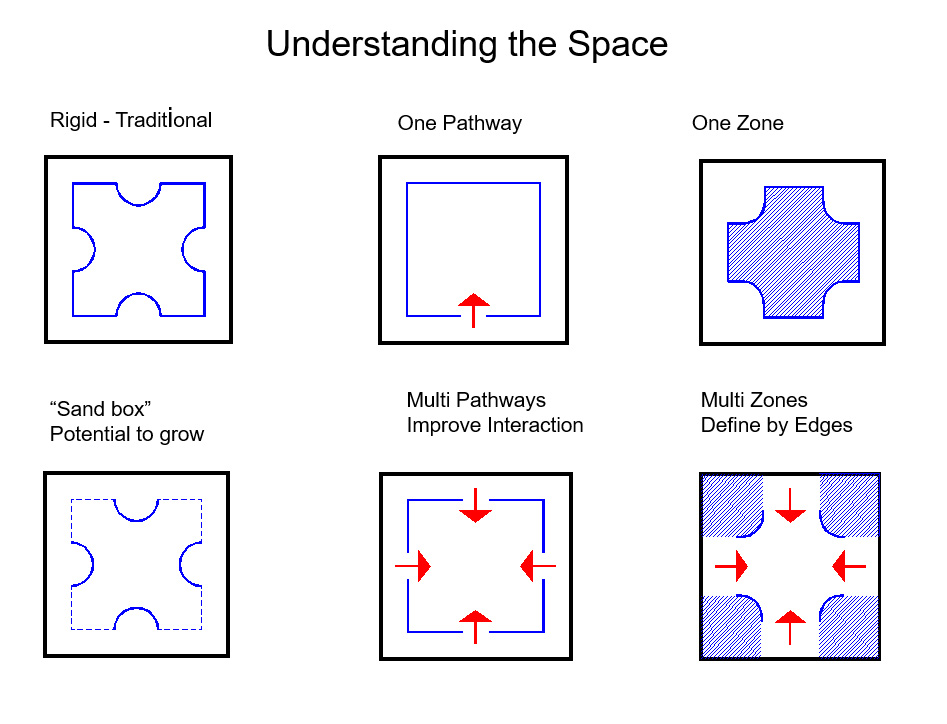
A library’s zones can support the collection. Our programs and development projects allows us to identity and test different strategies to make the learning space function and collections accessible.
A Case for Long Term Strategy
Condition assessment, circulation data, provenance, rarity, and alignment with current programmatic priorities all inform the library planning decision. For special collections and rare materials, we can use platforms such as AbeBooks and similar resources to get an idea of item values. The planning implication is straightforward: collection analysis can be integrated into the strategic plan reducing space pressures.
Libraries that build space planning into their strategic plans avoid the reactive, high-stakes deaccessioning events that damage institutional relationships and invite public scrutiny.
Generating New Content and Context
The challenge facing most academic libraries today is not the acquisition of new physical materials. It is the generation of context around existing holdings, particularly digital ones. Research published by Choice and JSTOR makes the problem concrete. Sixty percent of surveyed academic librarians identified lack of context as a primary stumbling block for undergraduate researchers using digital primary sources. Students, as one librarian observed, “often just don’t know what they are looking for, and when they find something they don’t know what they are looking at.” The materials exist. Here the space infrastructure around them can make a difference, providing learning pathways to both physical and digital collections.
Library Planning creates space both physical and intellectual.
Generating modern infrastructure is a form of collection development. The dimension here involves operational planning, not just space planning. Producing collections at scale requires instructional librarians, archivists, and subject specialists working in sustained collaboration with the community. That collaboration does not happen without organizational space strategy to support it.

Leveraging AI Without Surrendering Judgment
AI is already reshaping how researchers interact with library collections, and its influence will deepen. The question is not whether to engage with AI-powered tools but how to do so in ways that serve the collection’s intellectual integrity rather than compromise it.
The opportunities are real and scary at the same time. AI-assisted search can surface relevant primary source materials that would otherwise remain buried in large digitized collections. Natural language interfaces lower the barrier to entry for undergraduate researchers who lack the controlled vocabulary to navigate traditional catalog systems. Generative tools can assist with metadata creation, transcription of handwritten documents, and the identification of visual content in image-based collections.
The risks are equally real and scary because this affects how we work. Indeed, AI systems trained on incomplete or biased datasets reproduce those limitations in their outputs. Researchers who rely on AI-generated summaries without interrogating the underlying sources develop a false confidence in conclusions that may not be supported by the primary record. And institutions that outsource discovery entirely to algorithmic systems cede curatorial authority to vendors whose priorities are not necessarily aligned with the library’s mission.
4 Strategies for the Modern Library
Several principles emerge from this analysis that translate directly into planning practice.
- Align collection development with instructional goals.
- Build space planning into the strategic planning cycle.
- Invest in digital source and physical infrastructure.
- Treat library planning as part of your collection development work.
Planning as the Enabling Condition
The collection is never finished. That is not a problem to be solved. It is the nature of the library and the reason that planning, done well, is itself a form of stewardship.
