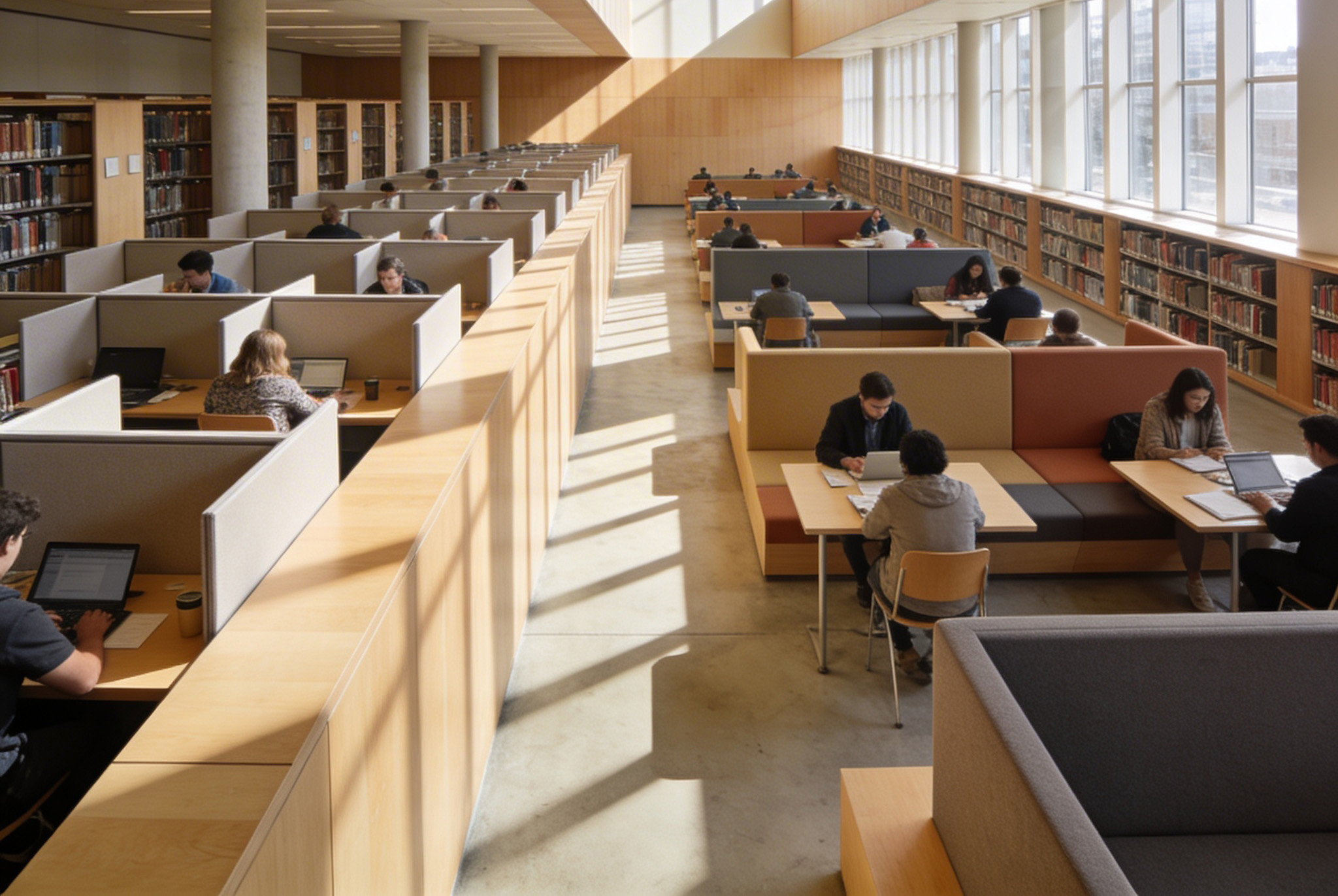
The library that serves its community well in 2026 is not the library that was adequate in 1995. It is a modern library whose air quality supports sustained cognitive work, whose acoustic zones are designed rather than improvised, and whose light enhances learning activities. We develop spatial functional layouts for public libraries. Each plan is aligned to the community it serves. These are not aspirational qualities. They are the baseline skills to modernize the library. The planning work required to achieve them is disciplined, evidence-based, and entirely within reach.
Air, Thermal Comfort, and Cognitive Performance
The relationship between the architect, engineer and library consultant is well documented. For example, we study indoor environmental quality and cognitive functions. Our practices include deep research about the functional make up of public libraries spaces and services. We work with architects and engineers to understand the thermal discomfort and poor ventilation that suppresses concentration, accelerates fatigue, and reduces the duration of productive study. In a library setting, where users may occupy a space for two to four hours at a stretch, functional building systems effects productivity.
Best practice establishes HVAC conditions of approximately 70°F with relative humidity between 30% and 50%. These are not aesthetic preferences — they are performance parameters. Sick building conditions, produced by aging mechanical systems, sealed fenestration, or inadequate air exchange, demonstrably reduce the cognitive output of the people inside them. Post-2010 renovations at institutions including DeSale University and the Millersville University library identified HVAC deficiency as a primary driver of user dissatisfaction and space avoidance. Correcting these conditions was not incidental to the programming work — it was foundational to it.
Sustainable public library space require specifications from library consultants. Energy-efficient lighting and climate control systems, natural ventilation strategies, and materials selected for low off-gassing contribute simultaneously to user well-being and long-term operational cost reduction.
CASE STUDY: The University of Galway’s forthcoming learning commons integrates these principles at the infrastructure level, treating environmental quality as a prerequisite for the collaborative and scholarly functions the space is designed to support.
Acoustic Zoning
Noise is the most frequently cited complaint in the library user surveys. NOTE, We can provide deep support to libraries looking to do a survey, understanding the library space, services and acoustical qualities of the spaces. Contact the Library Consultant
Research from the Journal of the Acoustical Society of America identifies four primary acoustic categories in library settings:
- quiet concentration zones
- collaborative
- social zones
- computer-use areas
Each requires distinct treatment. Quiet zones should not exceed NC-30 noise criteria. Collaborative spaces require sound-absorbing surfaces and strategic separation from adjacent study areas. Transitional zones — cafes, entry sequences, circulation desks — function as acoustic buffers when designed with that role in mind.
Sound transmission between adjacencies is a technical problem with architectural solutions: acoustic panels, demountable wall systems, raised floors with sound-dampening underlayment, and ceiling treatments that absorb rather than reflect.
CASE STUDY: At the DeSale University learning commons, factor analysis of student behavior confirmed that acoustic conditions were the primary determinant of zone selection — students chose spaces based on sound environment before any other variable. This finding has direct implications for programming: acoustic zoning is not a finishing detail. It is a primary organizational framework.
Calibrated to Activity and Circadian Function
Natural light is among the most powerful tools available to library designers, and among the most frequently underutilized. Daylighting reduces energy consumption, supports circadian regulation, and creates the quality of environment that users describe as welcoming.
CASE STUDY: The C.W. Post Library renovation at Long Island University demonstrated this directly: opening the building envelope to natural light transformed user perception of the space before a single piece of furniture was moved.
Artificial lighting must be calibrated to task. Workstations and reading areas require approximately 500 lux. Stack aisles and self-checkout areas function adequately at 300 lux. Lounge and social zones benefit from warmer, lower-intensity sources that signal permission to relax. Lighting systems that allow zone-level control — increasingly standard in new construction and achievable through retrofit — allow a single building to support the full range of library activities without compromise.
The integration of smart building technology, including sensors that adjust lighting and climate controls in response to occupancy and time of day, represents the current frontier. These systems reduce operating costs while continuously optimizing conditions for the users present.
CASE STUDY: The Stavros Niarchos Foundation Cultural Center in Athens, designed by Renzo Piano, demonstrates how natural light, spatial openness, and environmental responsiveness can be unified into a coherent architectural statement that serves both scholarly and community functions.
Wayfinding Reducing Ambiguity
A library that users cannot navigate is a library they will not return to. Spatial legibility — the degree to which a building’s organization is intuitively comprehensible — directly affects the confidence and comfort of first-time and infrequent visitors, including those with disabilities, those unfamiliar with library conventions, and those whose primary language differs from the institution’s signage.
Christopher Alexander’s work on pathways and entry sequences remains instructive: each point of information should be visible from the previous one, so that a user who is uncertain can find their way by observation rather than by asking for help. Applied to library programming, this principle argues for clear sightlines from entry to service points, logical adjacency between related functions, and signage systems that communicate through hierarchy rather than volume.
CASE STUDY: The DuPaul Richardson Library renovation applied this framework directly: the redesign opened sightlines across the learning commons, aligned circulation pathways with functional zones, and positioned the service desk to welcome rather than intercept. The result was measurable improvement in user confidence and a reduction in staff time spent on directional assistance.
Wayfinding must account for diverse movement patterns across the day. Morning users — often commuters seeking quiet individual study — navigate differently than afternoon groups assembling for collaborative work. Flexible spatial sequences, supported by clear zone differentiation and consistent signage, accommodate this variation without requiring staff intervention.
Framework for Human Development
The library’s role in human development extends well beyond information access. It functions as what Ray Oldenburg termed a “third place” — neither home nor workplace, but a setting that sustains community, conviviality, and the informal exchange of knowledge. This framing has practical design implications. Spaces that feel institutional, crowded, or unwelcoming suppress the social and psychological conditions under which learning occurs. Spaces that feel calibrated to human scale, that offer choice between solitude and connection, and that communicate care through their physical quality, enable them.
The cultural dimension of this equation is equally significant. Libraries serving diverse populations — including immigrant communities, students with disabilities, and users across a wide age range — must design for the full spectrum of those communities, not for a statistical average.
CASE STUDY: The Esperanza College Library in Philadelphia, which serves a large Spanish-speaking population, embedded this principle in its programming: multilingual materials, flexible study configurations, and digital access points designed for users at varying levels of technological fluency. The result is a library that functions as genuine civic infrastructure rather than a service available only to those who already know how to use it.
Reprogramming Underperforming Space
Every library contains zones that are underutilized relative to their footprint. Print journal stacks with declining circulation, staff areas configured for workflows that no longer exist, and reading rooms designed for a user population that has changed — these represent recoverable space. The discipline of resource rationalization asks planners to identify these zones systematically and redirect their square footage toward functions that demonstrably serve current and emerging community needs.
CASE STUDY: At the University of Maryland, a high-density repository relocated at-risk collections off-site, releasing floor space for flexible labs, seminar rooms, and collaborative study environments.
CASE STUDY: At Le Moyne College, a phased renovation over ten years transformed an underperforming library into a learning commons, quantitative reasoning center, and institutional archive — each function occupying space that had previously served a diminished purpose. At Stanford, the integration of an automated storage and retrieval system beneath the learning commons floor preserved collection access while eliminating the spatial footprint of open stacks entirely.
The principle in each case is the same: space is not neutral. Every square foot either serves the institution’s mission or it does not. Planners who treat deaccessioning, collection relocation, and functional reprogramming as politically difficult but technically optional are deferring a reckoning that compound interest makes more costly with each passing year.