

There is a concept that runs through every successful library project I have been part of, though it rarely appears in the programming, technical specification documents, manuals or the space utilization spreadsheets. Ranjay Gulati, professor at Harvard Business School, calls it Courage. He describes five strategies for driving bold action amid uncertainty, and when I read them, I recognized each one as a principle I have watched succeed — and watched fail — in library planning engagements across four decades of practic. Reframing it today, I think Courage is a key concept. Courage to embrace technology / courage to protect the past and courage to plan for the future. It makes a difference when you reframe the situation with courage.
The library that needs to change almost always knows it needs to change.
Bravery Is a Choice
Gulati’s first principle is direct: bravery is a choice. It is not a personality trait distributed unevenly among administrators. It is a decision, made or deferred, every time a provost looks at a library that has not been renovated in twenty years and decides whether to reframe the situation with courage.
In library space planning, that choice manifests in the willingness to conduct a genuine needs assessment — one that does not simply confirm what leadership already believes, but surfaces the actual conditions of the building, the collections, the seating capacity, and the service model. The three foundational variables in any library program are seating, collections, and staff operations. Each one can be measured. Each one can be compared against peer institutions. Each one tells a story that requires courage to hear and act on.
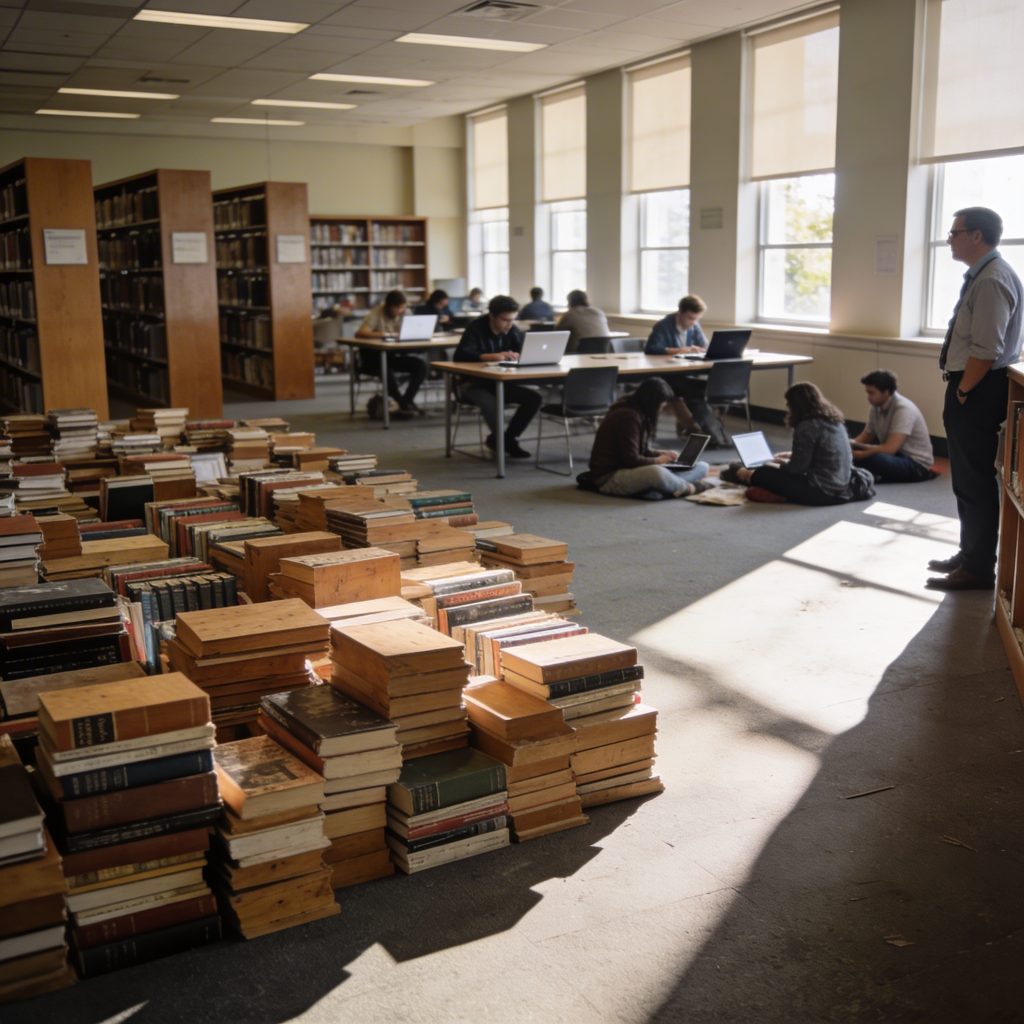
The inadequate library — the one where students sit on floors during finals, where bookstacks crowd out study space, where staff work in conditions that predate the internet — is not a mystery. It is a documented condition. What it requires is not more data. It requires someone willing to say: this is not acceptable, and here is what we are going to do about it.

Create a Positive Narrative
The second strategy is to create a positive narrative — for the library, for the community it serves, for the institution that funds it.
This is not spin. It is programming. When I work with a school, college or university library, one of the first exercises is to articulate what the library does well and build the case for investment from that foundation. Some people call this a SWOT analysis (strengths, weakness, opportunities, threats). Appreciative inquiry — the methodology of starting with strengths rather than deficiencies — is not merely a design thinking technique. It is a strategic design thinking tool for building the coalition that any significant library project requires.
The learning space, when it functions well, is one of the most compelling narratives in higher education. It is a stage for student success. It is the third place that Ray Oldenburg described — neither home nor classroom, but the social infrastructure where community forms. Passmore Edwards understood this in the nineteenth century when he built learning spaces for miners in Cornwall. The argument has not changed. What has changed is our ability to document the return on investment: studies consistently show that students who use the library frequently perform better academically and are more likely to graduate.
Build the library plan with data, and then build it again with stories.
Cultivate Confidence Through Best Practices
Confidence in any role, Gulati argues, comes from studying and applying best practices. In library space planning, this means knowing the standards — not as constraints, but as instruments of advocacy. Knowing the best practices and strategies for success.
- A minimum of 15 percent of a library building’s square footage should be allocated to staff and operations.
- Seating standards for residential undergraduate libraries suggest capacity for at least 25 percent of the student body.
- Individual study carrels require 30 to 40 square feet of assignable space. Collaborative workspaces function best when they are adjacent to collections and equipped with flexible furniture, writable surfaces, and reliable technology infrastructure.
- Environmental controls — temperature held at approximately 70 degrees, relative humidity between 30 and 50 percent — are not preferences for special collections stewardship; they are requirements.
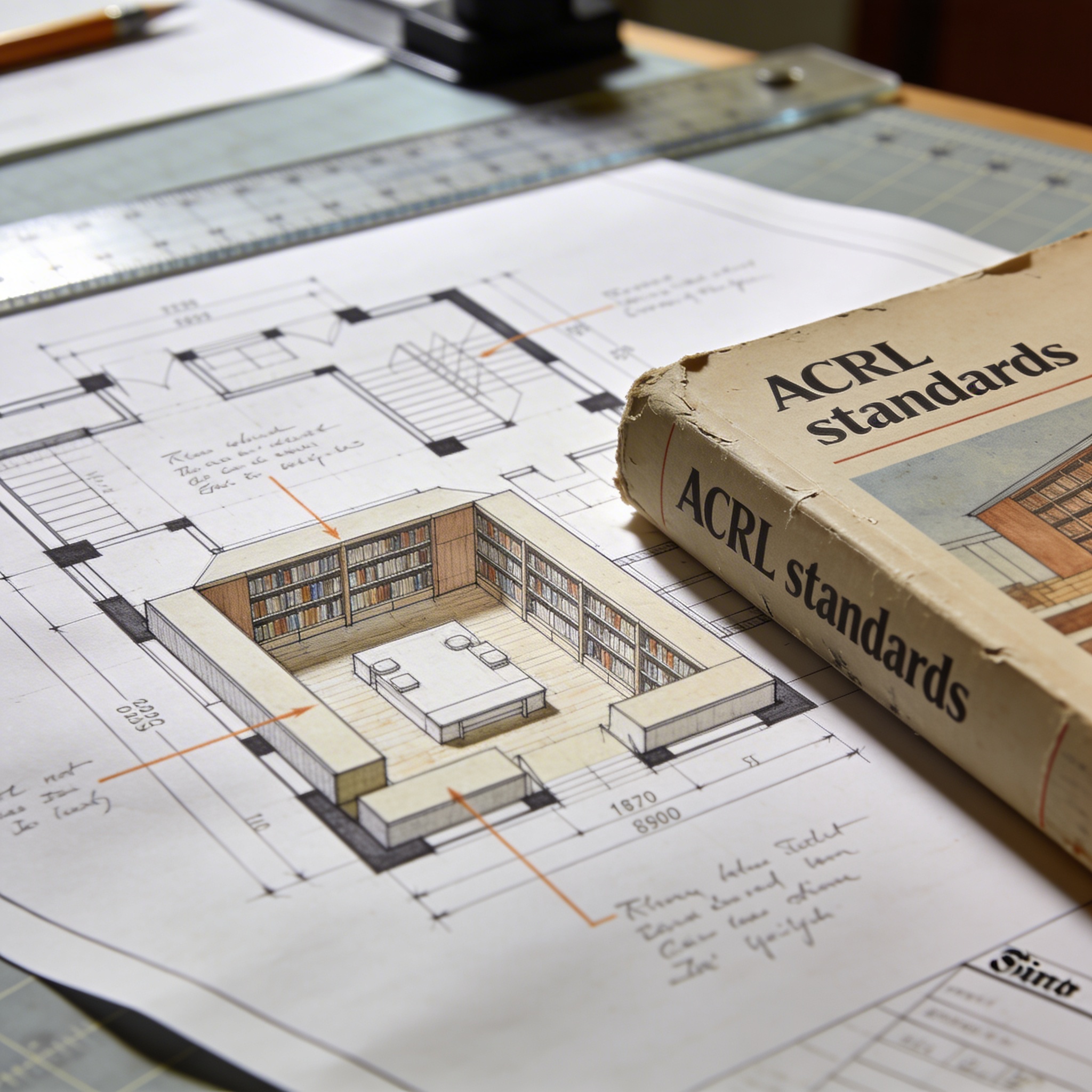
These are Aaron Cohen Associates, LTD numbers. They are the product of decades of behavioral research, space utilization analysis, and professional practice. When a library director walks into a budget meeting armed with ACRL benchmarks, peer group comparisons, and a well-constructed program document, the conversation changes. The standards give the argument structure. The confidence to use them comes from having done the work.
Take Small Steps
Going to the bottom of the Grand Canyon is nine miles down and five miles back — and those five miles are uphill. The lesson is not to avoid challenges. It is to pace yourself on the climb.
Library planning projects that fail often fail not because the vision was not ironed out. Because the implementation was structured as a single heroic act rather than a phased strategy.
- A 0-to-18-month reorganization of staff space and seating can generate momentum for a 3-to-5-year renovation.
- A 5-year renovation can build the case for a 20-year master plan.
- Each phase produces evidence.
Each phase builds trust with the leadership team, the facilities department, the faculty governance bodies, and the donors whose support will ultimately determine what gets built.
The visual scan — a facilitated walk-through of the library that documents spatial conditions, lighting, acoustics, collection density, and user behavior — is a small step with large consequences. It produces the shared vocabulary that makes subsequent conversations possible. It shows leadership what the library actually looks like through the eyes of a student. That shift in perspective is often the beginning of everything.
Evaluate Objectively
Staying attuned to the health of the library user, the community member, and the institutional partnership requires the discipline to evaluate objectively — to measure what is actually happening rather than what we hope or fear is happening.
This means space utilization and library service data. It means visitor status, interactive stats, circulation statistics and interlibrary loan patterns. It means surveys and focus groups and tabling in the student union or at a farmers market event. It means walking the stacks and counting the empty seats and the full ones. It means asking, without defensiveness, whether the collections are serving the curriculum or simply occupying floor space that students need for study.
For special collections and archives, objective evaluation includes condition assessment, environmental monitoring, and a clear-eyed analysis of access policies. For example, a rare book collection that no one can reach is not being stewarded — it is being warehoused. The goal of special collections stewardship is preservation in the service of access.
Let Meaning Emerge
Every library planning exercise is ultimately an exercise in finding connection — between the institution’s mission and its physical environment, between the collections and the people who need them, between the digital and the physical, between the past and the future the institution is trying to build.
Meaning does not arrive in the first workshop. It emerges through the process: through the visual scan, the needs assessment, the functional relationship analysis, the programming document, the schematic design, and the iterative review cycles that follow. It emerges when a faculty member sees the graduate study carrels and recognizes that the library has been designed with her research in mind. It emerges when a first-generation student finds a quiet seat during finals and stays for three hours.
The library is not a building. It is a set of relationships — between people and knowledge, between individuals and community, between the institution and its aspirations. The planning process, done well, makes those relationships visible and gives them a physical form.
Reframe the Situation
Gulati’s most important principle is to stay calm and reframe. In library planning, this means resisting the temptation to treat every constraint as a permanent condition. The library that is too small can be supplemented with high-density storage and a reconfigured adaptable commons. The collection that is too large for the available floor space can be weeded, digitized, or moved to a shared repository. The staff area that has not been updated since the 1980s can be redesigned to support the workflows of a twenty-first century library.
Big problems can be broken down through programming: seating, collections, staff services, and operations.
Courage, in library planning as in everything else, is not the absence of uncertainty. It is the decision to act well within it. The library your institution needs already exists in the data you have collected, the conversations you have had, and the standards you know how to apply. The work now is to build it.

