Library Learning & Ontology
Library modernization planning is the development of collections, seating and staff/operations. It is a furniture plan, technology refresh, and sequence of projects (capital and digital). Planning things matter, and they can create a modern and future service plan for your information team. The first task is very focused and fundamental: define what the library collection is in the intellectual life of the institution. Start thinking about this as ontological questions.
Ontological library consulting methods begin by asking what exists within the library system: collections, special collections, learners, researchers, staff expertise, patterns of access, habits of study, forms of literacy, and unrealized institutional ambition. During our workshops we ask the team how do they see the future? what are functional elements and how relate to one another? Library becomes a growing ecosystem when its spaces, services, collections, and communities are understood as growing and modernizing.
Modernization succeeds when when you define the user systems. For a public library, the question is not simply how to improve space. The question is how the library becomes a personal research space, literacy hub, gathering place, access to info resources, and catalyst for learning and literacy.
The Library as Learning Center
Ontological planning identifies the collection as a network of research areas. It gives the library its specific charge. Library must be more than a place where research is supported. It must become one of the places where research or learning is formed.
Can you make changes with our planning methods?
We support planning with our methods and models. They ask whether students can find books, seats, databases, and help. Literacy-center model directs the library as a place for advancing inquiry. For example, our methods ask whether seniors encounter materials, people, technologies, and ideas in ways that generate community. Our workshops invite users to ask whether the library’s indoor and outdoor spaces communicate the institution’s identity as a community of literacy.
Our planning questions help frame the discussion:
- How do the libraries serve as the community’s research hubs?
- What must change in the current spaces to make that vision real?
Our work belongs at the beginning of the modernization or capital planning process. It prevents premature solutions and helps avoid big mistakes. Basically, we prevent the common error of treating the library as passive containers. No library space is passive; if its stack locations, carrel arrangements, reading rooms, service points, exhibit areas, entrances, and restricted zones all express priorities. Our work clarifies the institution’s intellectual purpose or obscure it.
The library must also tell the right stories. Public library spaces, inside and outside, carry meaning. They represent continuity, literacy, access, community, and aspiration. Library modernization plans help us build the stories. Indeed, this is important. You need to tell people about why spaces are important, what stories they can offer, and what stories they should be to the user.
Literacy and Intellectual Infrastructure
Stakeholder engagement is an in-depth exercise. It is a form of discovery and sharing.
Every library contains visible and invisible networks of advocacy. For example, an Academic Faculty Member who depends on rare materials, and students who gather informally around shared research questions. You must be a librarian who understands patterns of use. You must be an archivists who knows the fragility and value of special collections. You must be an AI technologists who support discovery.
For example, special collections are a locus of passionate research advocacy. Special collections are not simply valuable objects held apart from general circulation. They are a distinct form of institutional memory and research capacity. Our stewardship requires environmental controls, security protocols, access policies, description, preservation infrastructure, and staff expertise. Basically, our value is intellectual, physical, and relational in the real world.
Our planning methods help frame what is needed:
- Who are the passionate advocates for research access in the academic community?
- Who are the library’s advocates?
- Who knows where things are breaking down.
- Who knows where collections remain underused?
- Who know which spaces discourage serious work and which spaces create community.
- How can you understand the difference between access as policy and access as lived practice?
Library gathers people around working together, generating memories, interpreting the collections, and innovation. Partnerships should be understood in those terms. The point is building an active library not a passive one. Library consultants align the users, collections, materials, and questions during planning work.
Space Assessment
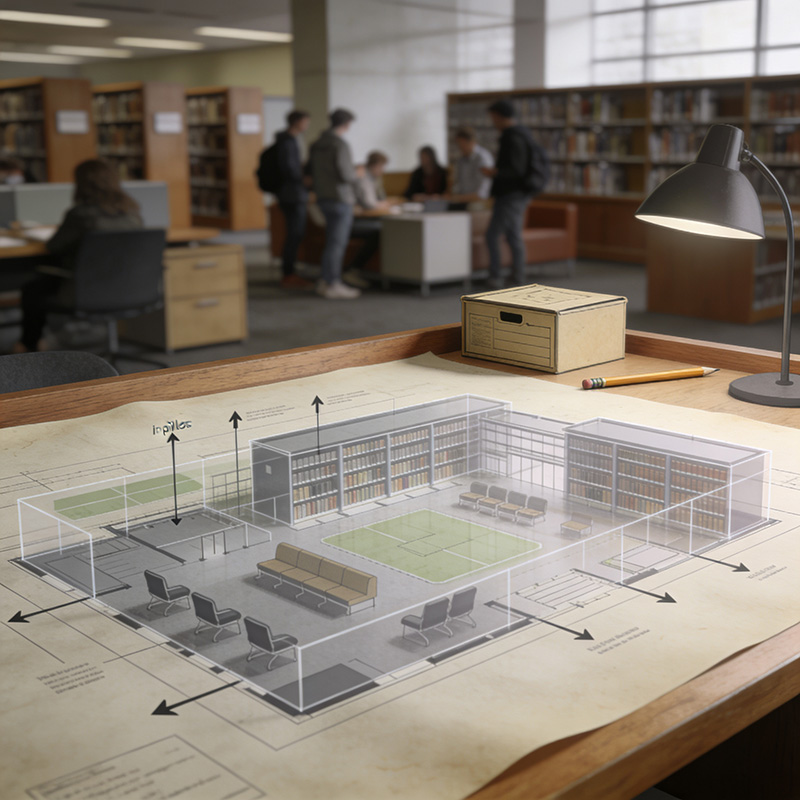
Successful library study can be assessed through four basic qualities: accessibility, comfort, activity, and sociability. These qualities are straight forward, and they are not superficial.
- Accessibility determines whether people can enter, navigate, locate, and use the space without friction.
- Comfort determines whether they can remain.
- Activity determines whether the space supports the work people came to do.
- Sociability determines whether individual study, collaborative inquiry, and informal exchange can coexist without destroying one another.
Carrel spaces are part of a traditional library plan. Indeed, the carrel is not merely a desk. It is a study space that enhances concentration, productivity, and duration of work. When we place these types of library spaces, we analyze proximity to noise, privacy, circulation, supervision, daylight, and access to collections. Basically, when carrels fail, they fail because the seating has not been aligned with the work space adjacencies.
- When you think about the library’s carrel spaces, which of these four qualities—accessibility, comfort, activity, or sociability—feels most lacking, and why?
- How do people currently move through and around the library buildings, and where are the missed opportunities for seating?
These are examples of questions that link wayfinding to capacity. Basically, they help us links capacity to usability. Good seating is critical. It is infrastructure for access that requires research, testing and analysis.
From Learning to Inventing
Innovation in libraries must support learning. Indeed, library must help convert learning into inventing. This means every user becomes an inventor in the technical sense. It means the library supports the movement from receiving information to producing insight.
Start by creating conditions in which the community, students, and children can interpret, work in, and share. We want to treats literacy as active capacity, not passive exposure.
- Literacy, in this context, includes the ability to navigate collections, evaluate sources, understand provenance, interpret rare and archival materials, use digital systems, and place evidence into argument. It also includes spatial literacy: the ability to understand where different kinds of work belong and how to use the library as an intellectual instrument.
An ontological method develops different pathways for different learners.
- The first-year student, the advanced researcher, the faculty member, the visiting scholar, the special collections user, and the community partner do not enter the library with the same knowledge or purpose.
- The library must support all of them without collapsing their needs into one generic user profile.
The question here is what activities make the library necessary at different rhythms of institutional life:
- What activities would compel adults and youth to spend time in the library?
- What is the current plan.
- What area functions differently across the day, the week, the month, and the year?
Quiet study, consultation, exhibition, instruction, independent research, collaborative work, and informal gathering each have their own cycles. Modernization must account for time as well as space.
Your Library must also ask how it can better support the talents and interests that already exist in the community. This is a disciplined question, because strongest plans do not import purpose. They reveal and strengthen the purpose already present.
Testing Before Building
Long-range planning and short-term action requires time and expertise. Library plans that cannot build a doable schedule soon loses credibility. Library plans that have no direction don’t make any progress.
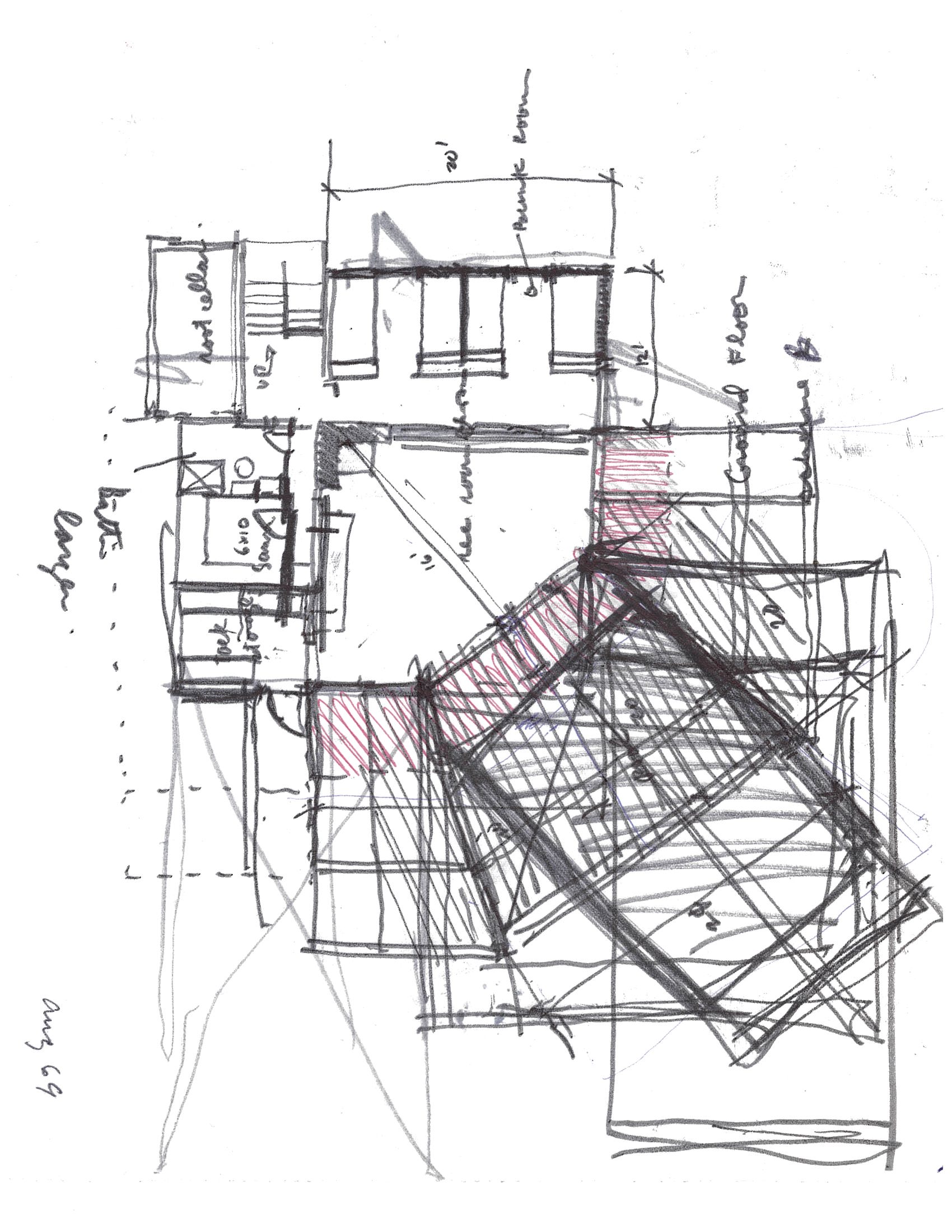
Our reports distinguishes between long term investments and reversible design tests i.e. low-cost changes in the next six months can demonstrate potential, reveal patterns, and build trust. Seating pilots, temporary service adjustments, pop-up research consultations, small exhibits, wayfinding improvements, lighting changes, and reconfigured study areas can show what the library is capable of becoming before capital decisions are made.
- What simple, low-cost changes could demonstrate the library’s potential as a literacy destination?
- Can stakeholders give you evidence?
- How are your community members responding to the proposal?
- How can new ideas for library spaces be tested before permanent investments are made?
Testing is part of the process. It helps with decision-making. It is responsible planning. It allows the leadership to learn from behavior, assess capacity, identify operational consequences, and refine assumptions. In library architecture and master planning, phasing is part of the construction process and strategy. It is a learning experience for everyone.
The Five-Year Test
Library plans need a long-term measures for success. Try this five-year question test to start:
- What would success look like for the library as a literacy anchor five years from now?
The answer will help you connect space, collections, special collections, literacy, access, and community. It will help you define your ability to enhance intellectual activity and radiate benefit outward.
Improvements to library should strengthen the broader academic and educational community partners.
- Better access to collections supports teaching, learning and scholarship.
- Better stewardship of special collections increases the use and protection of rare and unique materials.
- Better study environments improve persistence and seriousness of work.
- Better gathering spaces make interdisciplinary contact more likely.
- Better wayfinding and seating make the building more humane and more useful.
Aaron Cohen Associates, ltd ontological method gives coherence to the process. We have experience in this area. We can ask what the library is, what it holds, whom it serves, how knowledge moves through it, and what forms of learning it should make possible. You want to treat collections and services as related assets. You want to build special collections as active research infrastructure. Note, the users are learners with different intellectual trajectories.
Developing a library modernization plan is worthy when it begins with identity and ends with increasing control and capacity. It clarifies the institution’s research purpose, aligns stakeholders around access, assesses collections through use, builds literacy across learner types, tests change environments before fixing it in place, and measures success by the library’s power to strengthen the academic community.
The result is a new library that is growing. It is a library that knows what it is for.