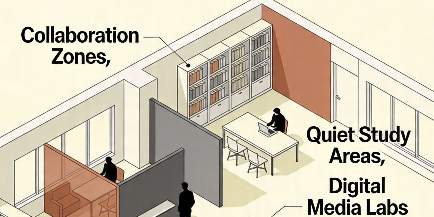

Collections Management
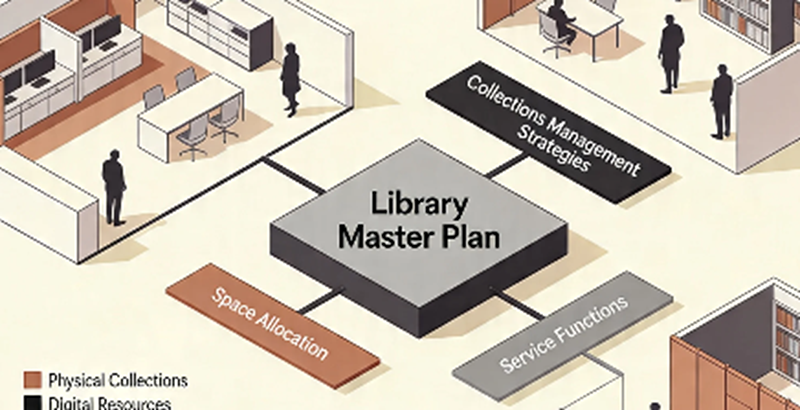
To understand what collections management actually is you need to start with a library master plan. During library master planning, collections management strategies are measured; both the stewardship of physical items and the extended list of digital materials. Indeed, access to e-books and related digital resources requires new types of resource optimization. To start a library master plan, try to analyze the service functions at your library: use of catalog, selection process for acquisitions, preservation resources, access and delivery.
Collections management influences space allocation because collections strategies determine:
- what must be physically present
- what can be accessed remotely
- what requires specialized environments
- how materials will be used.
Space planning that does not begin with a collections management strategy is planning without a foundation.
Effective Library Institutions
The most effective library institutions treat collections management and space planning as integrated strategies. They organize collections management around access, preservation, technology integration, and management. What if gets lost in the mix? What if the last person to analyze the collection retired or was replaced? Here, you have been given a gift. You have the opportunity to analyze the library’s organizational strategy (e.g. master plan). Basically, you can help make deliberate decisions about physical space and functions in the library. Normally, we do not treat shelving as a constraint imposed on collections and management. Best practice is to treat collections as the strategic driver that makes innovation possible.

Master Plan a Path Forward
The Master Plan is a path forward. It provides a framework to reexamine collections and an opportunity for management to realign services. Certainly, a library consultant can provide a methodology to improve the library’s strategic functions. This also includes organizational workflows, staffing or budget allocations. Hire a library consultant that share modernization techniques. Our work is a recognition that how a library manages its collections determines how effectively it can serve its users. Basically, how efficiently we can deploy services with the spaces we have and the possibilities uncovered.
Knowledge Management
Collections management is fundamentally a knowledge management design challenge. We see the library collection as not merely an accumulation of items, but an opportunity for growth. Indeed, a library collection is an organized body of materials selected and maintained to serve academic, education or cultural purposes. The strategic value of a collection depends on how well the leadership understands what the library does, what it holds, why it holds it, and how it is used.
Organizational Management
Organizations that realign collections management with a library master plan update their acquisition policy, collection assessment, user research, and evaluation of how materials are shelved. It answers important questions about what is the institution’s core mission. Here are a few sample questions:
- Which spaces and materials are underutilized?
- Where are the gaps in services, partnerships and operational efficiencies?
- What is the financial return on collection storage investments?
- What materials are part of the core collection(s), and which should be deaccessioned?
We provide workshops to help define space planning scenarios. Our library planning knowledge and experience enables use to research and support clear objectives for the collections. Here, you can make deliberate decisions about what materials to house on-site, what to make available through other mechanisms, and what space to repurpose for other uses. Indeed, a library master plan provides clarity. It helps us define what requires access, how we are wasting space and what deaccessioning and accession decisions are part of our modernization strategy.

Technology Integration
The integration of digital resources into collections management has fundamentally altered the relationship between materials and the space they occupy. E-books and other digital resources consume minimal physical space while demanding new forms of infrastructure: servers, bandwidth, hosting and cloud systems, security protocols and apps. Simultaneously, the availability of digital materials has changed user expectations about access, format, and permanence. AI provides another opportunity to gamify the library collection; something we are testing at Aaron Cohen Associates, LTD studios.
Redesign Opportunity
If you want to redesign you library, to make it more effective place for learning, a library master plan is the key. During this work, collections management is analyzed: access to information, entertainment, academic resources and educational partnerships. Physical collections remain necessary for materials that exist only in print, for materials where the physical object carries intellectual or cultural significance, and for materials whose value lies partly in their serendipitous tactile or aesthetic properties. Digital collections serve different user needs and allow for simultaneous access and broader distribution. The optimal service strategies typically involves a library master planning exercise that uncovered and modernizes the library services.
The library must allocate space not only for the materials themselves but for the technological infrastructure that enables access to digital resources. Collections management should be part of every library master plan. This helps leadership and management integrate technology effectively, shaping space planning, flexibility and technological readiness.