
Library
Capital
Planning
Start the Conversation
Building the Evidence Base for a Bond Campaign

The Night the Rendering Was Not Enough
Picture a library director standing at the podium of a city council chamber on a Tuesday evening. She has prepared for months. There is a rendering on the screen behind her: a handsome building with a glass atrium and a children's wing that opens to a courtyard. The architect has done good work. The director begins her presentation.
The questions start almost immediately. One council member asks how many people use the existing building on a typical Wednesday afternoon. Another wants to know what the library's cost-per-visit is compared to peer institutions in communities of similar size. A third asks what evidence supports the projected square footage of the proposed facility. The director has circulation statistics and a door count, but she does not have a space program, a population projection, or an independent feasibility study. The rendering answers none of these questions. The vote is tabled.
This scenario repeats itself in municipalities and on university campuses every year. The instinct to move toward design is understandable: people respond to images. But a capital request without an evidence base is a proposal without a foundation, and elected officials, trustees, and donors have learned to ask for one. Library capital planning consulting exists precisely to build that foundation before the first architectural line is drawn.
TL;DR
Three Pillars of a Fundable Capital Case
A capital campaign lives or dies on the strength of its evidence base, not its architectural renderings. Feasibility studies, behavioral observation data, and quantified community return are the three pillars that voters and trustees respond to. Library capital planning consulting connects institutional mission directly to construction dollars before the first design line is drawn.
What Library Capital Planning Consulting Delivers: The Feasibility Study

Four Questions Before the Cost Question
The word feasibility is commonly understood to mean: can we afford to build this. That is the wrong first question, or rather, it is the last question in a necessary sequence. A genuine library feasibility study answers four prior questions before it reaches construction cost. Who is the community this library serves, and how is it changing demographically and institutionally? What does the current facility fail to provide, documented through behavioral observation and space measurement? What programmatic requirements must a new or renovated building satisfy, expressed in precise square footage allocations and functional adjacencies? And what economic and educational return will the community receive on its capital investment? Only after those four questions are answered in documented form does the cost question become answerable in a way that commands confidence from a governing body.
The space-needs component is the architectural engine of the study. Drawing on the foundational methods articulated in Fraley and Anderson's Library Space Planning Techniques (1990) and built from decades of project experience across public, academic, government, law, medical, and special library environments, this firm develops a formal architectural program: a room-by-room, zone-by-zone specification of every function the building must house, with square footage allocations derived from observed and projected usage rather than from generic per-capita standards. That document becomes the brief against which architects design, the benchmark against which construction costs are estimated, and the evidence against which boards deliberate. Without it, the capital request is a wish; with it, the capital request is an argument.
The population and service analysis extends the study outward from the building itself. A public library feasibility study maps population growth trajectories, demographic shifts, and municipal planning documents against the library's current service envelope and capacity. An academic library study traces enrollment trends, curricular priorities, and research directions over a ten-to-twenty-year horizon. A specialized library study for a law firm, hospital, government agency, or corporate research department examines workload volume, regulatory requirements, and the geometry of specialized workflows the space must support. Every sector has its own analytical logic; the methodological discipline is consistent across all of them.
The operational performance component is often where the most candid institutional intelligence emerges. Circulation trends, program attendance, digital access statistics, staff-to-patron ratios, and facilities condition data provide an honest portrait of what the current building can and cannot do. When that portrait is set alongside peer benchmarks, it produces the kind of comparative evidence that resonates with budget officers and municipal finance committees: not anecdote, but documented evidence of capacity and constraint.
Components of a Complete Feasibility Study



Five Pillars of the Feasibility Study
What the Study Must Document
Each component of the feasibility study serves a distinct evidentiary function. Together they constitute the documented argument that a governing body can evaluate, challenge, and ultimately act upon with confidence.

Quantifying the Return: The ROI Model

The Economic Argument That Sustains the Vote
The most durable component of any capital case is its economic argument. Return-on-investment research for public libraries has become a mature and well-documented field. Across more than a dozen independent state and local studies compiled by the Library Research Service, public libraries have produced consistent economic multiples on their operating investment, with a mean return of $5.00 for every $1.00 invested. Individual state studies have ranged from $2.97 for smaller library systems to $10.18 in the Florida statewide analysis, with Pennsylvania reporting $5.50 and South Carolina $4.48.
The capital investment case has its own body of rigorous research. A 2021 working paper from the Federal Reserve Bank of Chicago, authored by economists Gilpin, Karger, and Nencka, examined the near-universe of U.S. public libraries between 1992 and 2018 and found that large-scale capital investment produced measurable, durable community gains: library visits increased by 21 percent, children's checkouts of items increased by 21 percent, and children's attendance at library events increased by 18 percent. Critically, these gains persisted for at least 10 years after the capital investment, not merely during the first season after ribbon-cutting. The researchers also found that a capital investment of $1,000 or more per student in nearby school districts was associated with an increase in children's reading test scores of 0.02 standard deviations. On a per-dollar basis, library capital spending produced test-score gains comparable to, and in some cases larger than, typical school capital investments.
The Urban Libraries Council's research report Making Cities Stronger, conducted by the Urban Institute and underwritten in part by the Bill and Melinda Gates Foundation, documents the economic development dimension of the return. The Carnegie Library of Pittsburgh was found to generate more than $91 million in combined economic output and to sustain more than 700 jobs. Researchers studying the new downtown Seattle Public Library found that the building contributed approximately $16 million in net new economic activity to the local economy in its first full year of operation alone. Library buildings attract foot traffic, anchor commercial corridors, and complement neighboring retail and cultural destinations in ways that private-sector developers have increasingly come to recognize.
For academic and specialized libraries, the ROI model is constructed differently but no less rigorously. Research productivity, faculty recruitment, accreditation standing, and student retention are the primary value drivers in an academic context, and library capital investment supports all of them. For law, medical, government, and corporate research libraries, the return calculation includes regulatory compliance, litigation risk reduction, and the productivity value of reduced search time and improved information workflow. The analytical framework is sector-specific; the discipline of quantification is constant. Assembling this argument also requires interpretation: the role of the capital planning consultant is to translate institutional performance data into language that a finance committee, a board of trustees, a provost, or a city council member can evaluate without a degree in library science.
Key ROI Findings
What the Research Documents
- A mean return of $5.00 per $1.00 invested has been documented across more than a dozen independent public library ROI studies (Library Research Service).
- Library capital investment increases library visits by 21 percent and children's event attendance by 18 percent, with gains persisting for at least 10 years (Gilpin, Karger, and Nencka, 2021, Federal Reserve Bank of Chicago).
- The new downtown Seattle Public Library contributed approximately $16 million in net new economic activity in its first full year of operation.
- The Carnegie Library of Pittsburgh generates more than $91 million in combined economic output and sustains more than 700 jobs.
- For specialized libraries in law, medical, government, and corporate settings, ROI documentation must encompass workflow productivity, regulatory compliance value, and institutional risk mitigation.
The Referendum Reality: What the Data Say About Winning at the Ballot
A Democratic Event With a Documented Track Record
For public libraries, the bond campaign is ultimately a democratic event. Understanding how voters decide is essential to building a campaign that wins. Library Journal and EveryLibrary track library ballot measures nationally each year, and their analysis of 2025 elections offers a clarifying picture. Of 87 library-related ballot measures tracked in 2025, 80 percent passed overall. But that headline figure obscures a critical distinction. Operating referenda, which ask voters to renew or extend existing funding for library services, passed at an 88 percent rate. Building and capital bond measures, which ask for new investment in facilities, passed at only 57 percent.
The ten-year average pass rate for library building and capital referenda is 66 percent, meaning roughly one in three library construction proposals fails at the ballot even in communities that broadly support their libraries as institutions. The causes are consistent across election cycles. Voters are comfortable preserving a service they know and use; they require genuine persuasion to fund something they cannot yet experience. John Chrastka of EveryLibrary, writing in Library Journal, put the distinction precisely: if renewal election days are about protection of an existing public good, new-money elections need to be persuasive that the service merits expansion.
Winning capital campaigns share a recognizable architecture. The most successful ones present a documented case for need that precedes any design. They establish that the current facility has quantifiable and independently verified deficiencies, that the proposed building is sized by evidence rather than aspiration, that the projected cost is set against a credible and specific return, and that the community was meaningfully involved in shaping the program. That is not a messaging strategy. It is the product of a rigorous planning process conducted well before the campaign begins.
The testimony of Doug McDonough, director of the Manchester, Connecticut Public Library, makes the relationship between the planning process and the electoral outcome concrete. Working from what McDonough described as a justification foundation developed with this firm's planning work, Manchester's taxpayers approved $39 million in a bond referendum. Combined with grant funding, that authorization covered a new approximately 75,000 square-foot main library at a new downtown location. The campaign succeeded because the community's representatives had been shown, in documented and defensible form, exactly what the investment would produce and why the case for it was sound. What a library consultant does in the months before a campaign begins is precisely this: it assembles the argument that sustains the vote.
Ballot Measure Data Points
What the Numbers Tell Campaign Planners
- Of 87 library ballot measures tracked in 2025, the overall pass rate was 80 percent; building bond measures passed at only 57 percent (Library Journal and EveryLibrary, 2026).
- The ten-year average pass rate for library building and capital referenda is 66 percent.
- Operating levy renewals pass at approximately 88 percent; new capital construction requests are a fundamentally different political proposition with a very different historical success rate.
- Voters in Loudoun County, Virginia approved a multi-departmental library bond with roughly 74 percent support in a high-turnout 2025 election.
- Campaigns built on documented space-need analysis, peer comparisons, and independently derived cost projections consistently outperform campaigns built primarily on narrative and imagery.
The Capital Planning Consulting Process: Five Steps from Data to Bond
A Cumulative, Credibility-Building Sequence
Library capital planning consulting follows a discipline that moves from community intelligence to documented program to financial argument. Each step builds the evidence base for the next. The sequence is not merely linear in order; it is cumulative in credibility. A board or council that has watched the process unfold from the beginning arrives at the capital request having already absorbed the reasoning behind it.
The Five Steps in Detail
From Community Intelligence to Capital Case
Step 1: Community and Institutional Analysis. The engagement begins with a structured assessment of the library's service population, institutional context, and long-range trajectory. For public libraries, this means population projections, demographic analysis, and a review of municipal capital and strategic planning documents. For academic libraries, it means enrollment and research trends, curricular direction, and peer institution benchmarking. For specialized libraries in law, medicine, government, or corporate environments, it means workload volume analysis, regulatory environment review, and the operational profile of the professional community the library serves. This analysis establishes the demand context: the documented case that the library is not merely a building in need of renovation, but a civic or institutional resource under quantifiable and growing pressure.
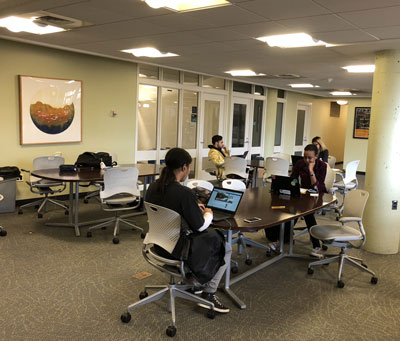
Step 2: Facility Performance Assessment and Visual Scan. The current building is assessed through structured behavioral observation and operational data review. The Visual Scan methodology, central to this firm's practice, involves facilitated walkthroughs with library staff, stakeholders, and community members who are guided to observe and evaluate space performance under real conditions. Usage patterns, circulation bottlenecks, technology gaps, accessibility deficiencies, and environmental shortcomings are documented as evidence rather than as impressions. The result is a facility performance portrait that is specific, observable, and reproducible: the kind of evidence that withstands scrutiny from a finance committee or a board of trustees. Learn more about how library consultants assess facility performance through the Visual Scan methodology.
Step 3: Architectural Programming and Space Needs Quantification. The architectural program translates the community analysis and facility assessment into precise spatial requirements. Every functional zone, service point, collection area, staff workspace, and technology environment is specified by square footage, adjacency relationship, and operational requirement. This document is drafted in collaboration with library leadership, staff, and key stakeholders, and it reflects observed behavior and projected use rather than aspirational square footage. The program becomes the contractual basis for the architect's work and the primary defense against scope creep, budget inflation, and post-occupancy disappointment.
Step 4: Return-on-Investment Modeling. The economic argument is assembled from multiple sources: peer institution studies, state and national research, operating data from the library's own history, and where applicable, economic development and real estate research specific to the project community. For public libraries, the model draws on output measures, community value assessments, and capital-impact research of the kind produced by the Federal Reserve Bank of Chicago and the Urban Libraries Council. For academic and special libraries, the model incorporates research productivity metrics, regulatory compliance value, and institutional mission alignment. The final document is written for a non-specialist audience: the governing board, the municipal finance committee, or the donor pool who will ultimately decide the campaign's outcome.
Step 5: Capital Case Documentation and Stakeholder Narrative. The evidence base is assembled into a capital case document that integrates community analysis, facility assessment, architectural program, cost modeling, and ROI argument into a coherent, readable, and defensible narrative. This document is the foundation of the bond campaign, the board presentation, the grant application, and the community engagement process. It is also the instrument that distributes campaign ownership beyond a single internal champion: when trustees, staff, faculty, community leaders, and donor prospects have participated in the planning process, they arrive at the capital request as co-authors of the argument rather than as an audience for it.
Putting It Into Practice
What to Do
- Commission the feasibility study before engaging an architect; the architectural program must precede the design, not follow it.
- Use structured behavioral observation, including facilitated Visual Scan walkthroughs, to document how your current facility actually performs under real conditions rather than relying on staff impressions alone.
- Assemble ROI data from peer institutions in comparable communities, not only from national averages, so that local decision-makers can see their own situation reflected in the evidence.
- Map population or enrollment trends against building performance over at least a ten-year window to establish the trajectory that justifies your projected capacity.
- Present the capital case in three registers simultaneously: the community benefit argument for voters and the general public, the operational efficiency argument for budget officers and finance committees, and the institutional mission argument for trustees, academic leaders, or governing boards.
- For academic and specialized libraries, include research productivity, regulatory compliance, and accreditation implications in the return calculation alongside physical performance metrics.
- Build the community narrative from authentic stakeholder voices gathered through structured focus groups and facilitated observation sessions, not from generic library advocacy language.
What to Avoid
- Leading with architectural renderings before the space program is complete and independently validated.
- Conflating operating levy renewal success rates with building bond success rates when projecting your campaign's prospects: they are fundamentally different political propositions with very different historical pass rates.
- Presenting ROI figures without tracing the methodology used to calculate them; trustees and council members will ask, and the answer matters to the credibility of the entire case.
- Sizing the building from rules of thumb or square footage-per-capita formulas without a documented program analysis specific to your community and service model.
- Allowing a single internal champion to carry the campaign; durable campaigns distribute ownership across the stakeholders who participated in the planning process from the beginning.
- Beginning community engagement after the design is already fixed; genuine consultation must occur before the program document is finalized, not after schematic design is complete.
Questions to Ask Before You Begin
A Diagnostic Checklist for Trustees and Administrators
- Has a space needs analysis been conducted that is specific to our service population, derived from observed behavior and institutional data rather than from regional or national averages?
- Can we document, with behavioral observation data and a facilities condition assessment, exactly what our current building fails to provide?
- What is our community's current economic return on its library investment, and what additional return does the capital project specifically project over a ten-to-twenty-year horizon?
- Are our projected population or enrollment trends sufficient to justify the scale of the proposed building for a twenty-to-thirty-year service life?
- Have we engaged likely opponents of the bond proposal directly in the planning process, so that we understand their objections before the campaign begins?
- Is our capital case built on data that can withstand independent scrutiny, or does it rest primarily on images and institutional advocacy?
Related Reading
Explore the Firm's Methodology in Depth
- Library Space & Service Planning Consultants | Aaron Cohen Associates
- Public Library Design Consulting: Community-Centered Planning from Needs Assessment to Opening Day
- How Library Consultants Assess Facility Performance: The Visual Scan in Practice
- What Does a Library Consultant Do? Roles, Methods, and When to Hire One
- Library Consulting & Strategic Planning for Modern Learning Ecosystems
- Library Planning Fundamentals
Begin Your Capital Planning Engagement
Sources
Research Underlying This Analysis
- The Returns to Public Library Investment (Federal Reserve Bank of Chicago Working Paper WP 2021-06)
- Summary of Recent Public Library Return on Investment Studies (Library Research Service, Colorado State Library)
- Protection, Not Expansion: Library Referenda 2025 (Library Journal)
- Making Cities Stronger: Public Library Contributions to Local Economic Development (Urban Libraries Council / Urban Institute)