
Library Data
Insights
Consulting
Talk to Us
TL;DR
Building Curated Research Access for Educators, Government, and Organizations
Most educators, government agencies, and organizations lack the institutional infrastructure to build a reliable discovery environment, leaving researchers exposed to unvetted sources and hidden source-quality failures. A curated, members-only reference portal with editorial governance and a catalog-grounded AI research desk provides structured access to authoritative resources without the overhead of a full digital library build. The five-step planning framework turns scattered usage patterns into a coherent service model that closes real gaps in research access and builds lasting digital literacy.
The Policy Brief That Could Not Be Sourced
When Infrastructure Fails the Researcher
Consider a state policy analyst assigned to produce a legislative brief on water rights precedent, due in seventy-two hours. Her agency has no subscribed databases, no librarian on staff, and a government intranet last updated during a previous administration. She opens a browser and types her query. What returns is a mix of news aggregators, vendor landing pages, and opinion pieces from organizations with clear interests in the outcome. She spends three hours sorting results, never confident she has reached the most authoritative source on federal case law or the historical record of similar legislation in neighboring states. She produces the brief. Her supervisor cannot tell whether the sources she cited are the best available.
This is not an unusual situation. It plays out daily in school district curriculum offices, municipal planning departments, nonprofit policy shops, professional associations, and small government agencies across the country. These organizations are not indifferent to research quality. They simply lack what library data insights consulting has long identified as a discovery environment: a structured system of vetted, navigable, authoritative resources organized around the actual research needs of a defined community. They have legitimate research requirements and no institutional infrastructure to meet them.
The practical question is not which platform to license. It is how to give these communities reliable access to authoritative information without asking them to undertake a full digital library build, with all the planning, procurement, staffing, and ongoing curation that entails. A curated reference portal, designed with editorial discipline and supported by a research desk that knows its own catalog, is a proven model for closing that gap. It is also the model from which the most durable digital literacy outcomes grow.
Structuring vetted, navigable, authoritative resource systems around defined community research needs — the core discipline that separates a real discovery environment from a general search engine.
Establishing and maintaining the selection criteria, exclusion principles, and ongoing review processes that keep a reference catalog trustworthy rather than merely comprehensive.
Anchoring AI-assisted research tools to a vetted catalog rather than the open web — producing research pathways with editorial accountability, not algorithm-surfaced results.
Translating access to authoritative sources into lasting research judgment — bridging the gap between reaching a source and understanding how to evaluate and apply it.
The Discovery Environment Gap

What It Costs Organizations
The scale of the access problem becomes clear when you examine what public libraries have absorbed in its absence. A 2020 Public Library Technology Survey conducted by the Public Library Association found that more than 88 percent of all public libraries offer formal or informal digital literacy programming, and that more than 93 percent of U.S. public libraries offer digital collections. Libraries have taken on a significant share of the demand that other institutions cannot meet. But libraries serve individuals who come through their doors. Educators who need research support for curriculum development, government analysts who need vetted data for policy briefs, and organizational researchers who need a navigable starting point for strategic work are not primarily served by the public library's open-door model. They need a managed environment configured to their professional context.
The same PLA survey revealed a structural asymmetry that library data insights consulting practitioners recognize immediately. While more than 65 percent of city libraries reported having full-time library IT staff, only 11 percent of town and rural libraries reported the same. Organizations entirely outside the library sector have no such staff at all. They are not simply under-resourced relative to large urban institutions. They are operating without any discovery infrastructure, which means their researchers are making source-quality judgments without the training, the tools, or the institutional support to make those judgments well.
The cost of this gap is not simply inefficiency. When a teacher builds a curriculum unit around whatever the first three search results return, students learn from whatever the algorithm surfaced. When a government analyst cites a secondary aggregation rather than the primary source, the policy brief carries a hidden risk. When an organization makes a strategic decision on the basis of whatever its staff could locate through a general search engine, the quality of that decision is bounded by the quality of the search, not the quality of the available evidence. These are not abstract concerns. They are the routine consequences of organizations that need a knowledge base and do not have one.
The Access Gap in Numbers


The Curated Reference Portal
Editorial Discipline as a Library Service
The traditional response to the discovery environment gap is to propose a full digital library build: assess needs, select platforms, license databases, train users. For institutions with capital budgets, planning staff, and time, that is the right answer. For the school district curriculum director, the government policy office, and the professional association research team, it is an answer that arrives too late, costs too much, and requires expertise the organization does not have. What they can adopt immediately is a portal designed by people who have already done the curatorial work.
Reference Library Place represents a mature application of this model. It is a members-only editorial reference library organized into twelve departments covering General Reference, News and Current Events, Science and Nature, Government and Law, Business and Finance, Arts and Literature, History and Biography, Geography and Travel, Language and Learning, Everyday Tools, Technology and Web, and Diversions. The catalog holds more than 200 individually reviewed entries, each selected because it is a primary or authoritative source in its domain, or a genuinely useful tool with no obvious substitute. Commercial content farms, SEO-optimized aggregators, and link-wall sites are excluded on explicit editorial principle.
The selection criteria matter as much as the selections themselves. A catalog built on the principle of trustworthiness rather than comprehensiveness produces a fundamentally different research experience. Under Government and Law, the Cornell Legal Information Institute sits alongside the Library of Congress and the Federal Register. Under Health and Medicine, the Mayo Clinic and MedlinePlus appear alongside the Cochrane Library's systematic reviews. Under Language and Learning, Etymonline and the Oxford English Dictionary are featured alongside Purdue OWL and Strunk and White. These are not the results a general search engine returns first. They are the sources a skilled reference librarian recommends, and that distinction is the entire point.
The portal traces its catalog directly to refdesk.com, the human-edited reference directory that Bob Drudge began publishing in June 1995 and ran for more than two decades. Drudge, the son of a librarian, built Refdesk as an early attempt to organize the chaotic early web as a human-curated resource rather than an algorithmic one. Reference Library Place extends that lineage with editorial rigor and typographic seriousness its predecessor never claimed, treating curation as an editorial discipline rather than a technical task. Access is managed through a reader's card system: visitors apply, an editor reviews the application by hand, and the decision is recorded with any editorial note attached to the reader's file. The portal also publishes a daily edition with a Site of the Day, a Word of the Day, historical chronicle entries, live news headlines refreshed every half hour, and market data. This almanac structure gives the portal a living quality that static directories lack, and it gives members a reason to return daily rather than only when research pressure forces a visit.
Government, law, science, business, history, language, and general reference — organized by research domain rather than by platform or vendor relationship.
Hand-reviewed applications preserve an institutional quality standard from the first point of entry — a deliberate policy that reflects the portal's editorial identity, not a technical constraint.
Site of the Day, Word of the Day, historical chronicle, live news headlines, and market data build habitual professional engagement rather than emergency-only use.
Editorial lineage from refdesk.com establishes a proven model of human-curated reference that predates and outlasts algorithmic directory approaches by decades.
Turning Access Into Literacy

Library Data Insights Consulting: The Bridge Between Source and Skill
Access to authoritative sources is a necessary condition for good research. It is not a sufficient one. A researcher who can reach the Federal Register but does not know how to navigate it has not gained much. A teacher who can access the Cochrane Library but cannot evaluate what a systematic review means for her discipline is not better served than one who relies on a general news site. The transition from access to literacy requires a bridge, and that bridge is what the academic library has increasingly been redesigned to provide.
The ACRL Research Planning and Review Committee's 2024 report on top trends in academic libraries identifies AI literacy as a central concern across the profession. Researchers Duri Long and Brian Magerko define AI literacy as a set of competencies that enables individuals to critically evaluate AI technologies, communicate and collaborate effectively with AI, and use AI as a tool at home, in the workplace, and online. That definition is broader than it might first appear. It encompasses not just the ability to use generative AI tools but the judgment to evaluate what those tools return, to understand their limitations, and to know when to route a question to a vetted catalog rather than a large language model trained on the general web.
Reference Library Place addresses this directly through its Reference Desk. Card-holding members can submit a research question and receive a structured four-part response: the question restated, a direct written answer, three to five catalog entries with a one-line explanation of why each is relevant, and three to five ready-to-run search queries with real operators explained. The critical distinction is that this AI-assisted desk is grounded in the portal's own vetted catalog, not in the general web. A question routed through the Reference Desk returns sources the editorial team has already reviewed. That is not a small difference. It is the difference between a conversational AI tool and a reference librarian who knows her collection.
For organizations without a library tradition, this model offers something a general knowledge base platform cannot: a research environment with editorial accountability built into its architecture. When a government analyst submits a question about clean water regulation history, the Reference Desk does not surface the most popular results from an uncurated web index. It draws from a catalog that includes the Federal Register, the Library of Congress, and other primary sources chosen precisely because they are authoritative. The analyst gets a research pathway, not a search result. That distinction is precisely what building a digital library from the ground up is designed to produce, and it is what this portal delivers without requiring a full institutional build.
The Five-Step Framework
Building Digital Library Access From the Ground Up
The planning framework below applies whether an organization is commissioning a full digital library build or evaluating whether a curated portal can serve as its primary discovery environment. In either case, the sequence is the same: understand what users already do before deciding what to build or adopt. This is the core principle of library data insights consulting applied to digital access planning, and it is the only sequence that produces a service environment the community will actually use.
Planning begins with the inventory. The useful question is not what a library or organization licenses. It is what researchers actually use. The instrument should cover news and journalism databases, audio archives, primary source collections, scholarly databases, general search engines, and AI tools such as ChatGPT, Microsoft Copilot, and Gemini. The last category needs explicit attention. Researchers in every sector already use general-purpose AI tools whether or not the organization endorses them. The planning question is not whether these tools belong in the research environment; they are already there. The question is how the organization will support their use responsibly. The inventory should also include fields for other and none of these. Unexpected answers often matter most: when a department relies on a resource the institution never knew about, the plan has a gap; when a department uses nothing at all, the plan has an opportunity.
An inventory shows what exists. An assessment of challenges shows what fails. This second set of questions should ask users plainly where their research breaks down. The common challenges fall into four groups: access, meaning getting to paywalled or restricted content and finding international perspectives beyond domestic sources; evaluation, meaning assessing whether a source is relevant and credible for a specific question; navigation, meaning working through large archives without specialist search knowledge; and skills and judgment, meaning developing research capacity and maintaining citation transparency when AI tools are part of the process. Each challenge points to a different kind of service response. Collapsing them into a single overall satisfaction question produces an answer that fits none of them precisely.
Rate existing resources against each type of source the organization's research actually requires: written journalism and news analysis, historical broadcast and radio material, audio programs and podcasts, international media monitoring, primary government documents, and scholarly literature. Rating each type separately keeps a strong area from hiding a weak one. An organization well served by written journalism and badly served for primary government documents will miss that gap entirely in any overall satisfaction measure. This step also surfaces a common blind spot: audio and broadcast material is routinely treated as marginal until a research question makes clear it is primary evidence. Asking about it explicitly makes it visible in the plan.
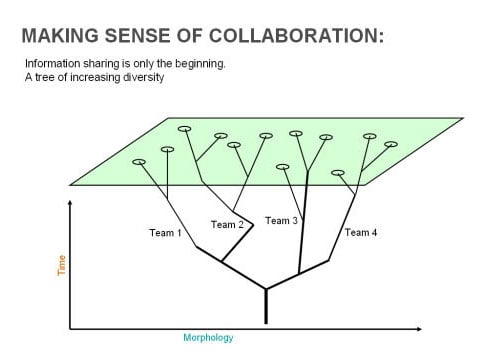
Survey results are data. They are not yet shared understanding. Following the dialogue model advanced by Glenna Gerard and Linda Ellinor and applied in change practice by P. Holman and Tom Devane, the planner brings findings to a cross-section of stakeholders and uses them as the starting point for structured inquiry rather than as a verdict. The guiding questions are open ones. Why do researchers turn to general AI tools before vetted catalogs? What does difficulty with source relevance say about how assignments or briefs are designed? Why are international perspectives scarce, and who made that decision? In dialogue, participants examine their assumptions before defending them. A faculty member may assume students lack search skills; a librarian may assume faculty never assign archival work. Dialogue gives both assumptions room to be stated, tested, and revised. What comes out is a shared picture of the organization's real research life, and that picture is the only reliable foundation for a service plan that lasts.
With shared understanding in place, the planner can build the service plan. Access challenges call for a licensing strategy or the adoption of a curated portal with appropriate departmental coverage. Evaluation challenges call for curated pathways, contextual guidance, and source-assessment support embedded in the discovery environment. Navigation challenges call for discovery design that serves the non-specialist, which is precisely what a well-structured portal catalog achieves. Skills and judgment challenges call for instruction, including explicit guidance on citation transparency when AI tools are part of the research process. Coverage gaps identified in the third step set acquisition priorities. The inventory from the first step shows what to keep, what to consolidate, and what to retire. The resulting service plan describes an environment that reflects what the organization actually needs, not what was easiest to license.
Putting It Into Practice

What to Do

Action Principles for the Planning Team
Start with an inventory of what researchers actually use, not what you think they should use or what the organization has already licensed. Treat evaluation and navigation challenges as services that require deliberate design, not features that come pre-installed in a platform. Use the dialogue method to surface hidden assumptions about research workflows before making any platform or collection decision.
Evaluate a curated portal with editorial governance before committing to a full digital library build; for many organizations, it is the right long-term answer, not a stopgap. Insist that any AI-assisted reference tool be grounded in a vetted catalog rather than the open web; the difference in source quality and institutional accountability is substantial. Build daily use habits into the discovery environment through editorial content, standing features, and curated news access so the portal becomes a professional routine rather than an emergency resource.
What to Avoid
Do not select a platform before completing a user inventory; this produces a knowledge base that reflects what was available, not what was needed. Do not conflate access with literacy; a researcher who can reach an authoritative source but cannot evaluate it has gained very little practical capability. Never assume that general AI tools eliminate the need for curated, authoritative source lists; an AI grounded in a vetted catalog is a fundamentally different instrument than one trained on the open web.
Avoid using a single overall satisfaction rating to assess resource coverage; it will consistently hide subject-area gaps that category-by-category assessment reveals. Do not treat audio, broadcast, and international sources as marginal additions to a text-based core; for many research questions in policy, history, and media studies, they are primary evidence. Never skip the dialogue stage and move directly from survey data to procurement; data without shared interpretation builds collections that drift out of alignment with community needs within a few years.
Questions to Ask
Diagnostic Questions for the Planning Process
Before any platform decision, any procurement, or any organizational commitment to a discovery model, the planning team should work through the following questions with the stakeholders who actually conduct research. These are not rhetorical questions. Each one is designed to surface a specific category of hidden assumption or infrastructure gap that the planning process must address before it can produce a coherent service model.
What do your researchers actually open first when they begin a research task, and why that source rather than others? The answer reveals the de facto discovery environment the organization already has — and whether it reflects deliberate design or accumulated habit.
Where does the research break down: at the point of access, at the point of evaluating source quality, or at the point of navigating what they find? Each breakdown point indicates a different kind of service gap and a different kind of planning response.
Which source types are entirely missing from your current environment, and what research questions does that make impossible to answer well? The absence of government documents, international sources, or primary legal material is not a gap researchers report spontaneously — it must be surfaced by explicit category-by-category inquiry.
Who in your organization needs research access but has never been asked what they need? The planning process consistently underweights the research requirements of departments that do not self-identify as research users — procurement teams, communications staff, and program managers who routinely make evidence-dependent decisions without any discovery infrastructure behind them.
If your team adopted a curated reference portal tomorrow, which departments would use it immediately and which would need instruction to understand its value? This question identifies where onboarding investment is required and prevents the common failure mode in which a well-designed portal goes underused because no one explained to the people who need it most why it is better than their current practice.
What is the actual cost to your organization when a researcher cites a secondary aggregation rather than the primary source, and can you identify a recent case where that happened? Naming a specific, recent instance of source-quality failure converts an abstract infrastructure argument into a concrete institutional risk — and that is the argument that moves planning processes forward.
Related Reading
Continue the Research
The frameworks and service models described on this page connect directly to the broader body of practice Aaron Cohen Associates has developed across digital library planning, literacy design, and strategic service development. Each of the following pages extends a specific dimension of the work described here.
Building a Digital Library From Scratch: Start With Questions, Not Platforms — the full planning sequence for institutions commissioning a discovery environment from the ground up, beginning with the community dialogue that precedes any platform or collection decision.
Digital Literacy and the Academic Library: Designing for Judgment, Not Just Access — how the academic library has been redesigned to build research judgment rather than simply provide access, and what that redesign means for institutions that do not have a library tradition.
The Digital Library Service Plan: Translating Dialogue Into Acquisitions, Discovery, and Instruction — how the dialogue method produces a service plan that holds up under budget pressure and institutional change, and how that plan differs from a simple platform procurement.
Digital Library Development — frameworks, dialogue methods, and service planning sequences for institutions building or rebuilding a digital library from the ground up.
For a broader view of how space planning, strategic programming, and data-driven consulting combine into a coherent institutional framework, the firm's services overview and strategic planning practice provide the institutional context within which digital access consulting sits.
Sources
Reference Library Place: A Daily Almanac for the Curious
2024 Top Trends in Academic Libraries: A Review of the Trends and Issues, ACRL Research Planning and Review Committee, C&RL News Vol. 85 No. 6
National Survey Finds Libraries Play Expanded Role in Digital Equity, Bridging Gaps in Access to Technology, Public Library Association, American Library Association, 2021
Reference Library Place: A Members-Only Editorial Reference Library, System and Editorial Architecture Description