

Posts Tagged Library Space Planning
Education is Changing – Libraries Enhance Learning Support
Posted by acohen in Library Planning Research, work in progress on May 9th, 2013
Library buildings can be designed to enhance learning support and research. Librarians can support the workflow of their researchers by directly supporting, managing and aggregating the content. These days there are plenty of librarians preaching community, but what about how we can design libraries to enhance the digital world?
Libraries are places where solutions are possible through access to knowledge and higher education. Planning learning environments requires us to be aware of new opportunities in education technology, open-source software or open-access publishing.
According to “Open Online Courses – an avalanche that might just get stopped“- In the US, the growing chorus for online education through massive open online courses, or moocs, has been deafening.” For example, the California legislature created a bill for the “New University of California” – one that offered no instruction but would issue credentials to people merely for passing exams. Does this model assure that our students are learning in the online world?
The New University of California bill did not pass, but California lawmakers detailed a plan on May 8, 2013 to require the state’s 145 public colleges and universities to grant credit for low-cost online courses offered by outside groups, including classes offered by for-profit companies.
The bottom line is that there really is no replacement for face-to-face interaction between teachers, professors, librarians and students. Digital and online methods can enrich those interactions, but it is no match for the community of services at our Universities and Colleges provide; the community of professors, tutors, peer mentors, librarians, IT help, libraries, computers labs, disability services and academic support.
It seems unlikely that libraries and learning spaces can be replaced by online learning without considerable investment in electronic resources. No wonder 72% of those who have taught moocs over the past three years believe students who took their classes had not done sufficient work to deserve credit from their institution.
Libraries and Learning Commons can be created with clusters of valuable and distinctive services. Librarians can ensure that the learning environment, enhances the reputation of the community, faculty and the institution. Librarians will continue to ask – What services does the community need? How can their output be preserved, discovered and re-used?
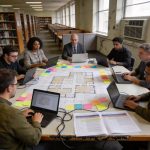
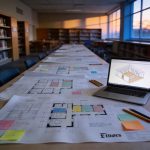
You can think of the Learning Commons as an incubator. It is an “I-Lab” – a multifunctional and fluid space for learning. The photo below is a visualization board that is at the Mathematics Museum in New York. It is an example of a physical environment that will support online learning technologies.
Visualizing the Library of the Future
Posted by acohen in Library Planning Research, Space Planning, work in progress on April 17th, 2013
NC State developed a wonderful video for their new library project. The video shows all of the different programmatic components required for a modern academic library including socializing, preservation and late night study.
Librarians can develop a proactive position when facing the future. Review this video to reflect and visualize the types of interactions and technology that can be in a library.
In a world of homogenized choices, the library can be the space where your community can feel truly fulfilled in their quest for knowledge, enlightenment, entertainment and connection to others.
Mentoring in the Library Incubator
Posted by acohen in Library Planning Research on February 28th, 2013
The library is a place where you can organize a form in an informal and relaxed atmosphere. It is a place where you can engage in discussions and catch up on current information. It is an incubator for students as they grow and mature.
Mentoring is when you take the time to hear about peoples experiences. It is when there is a common place to join in the discussion, start a new interest or relax. The social atmosphere allows participants to share experiences, reducing the confusion around doing research.
The incubator concept benefits educators and librarians, tapping into the reality that a place can be really helpful. The librarians facilitation; so much more than mentoring is happening. It is extremely important to start to visualize the paradigm shift. We can gather insight by sharing personal perspectives on how libraries provide information access. 
JOIN US ON MARCH 22, 2013 – TO DISCUSS — LIBRARY AS AN INCUBATOR FOR LEARNING
the language of library space
Posted by acohen in Library Planning Research, Social Library Issues, Space Planning on December 20th, 2011
A recent article from Inside Higher Education focuses on the need to balance quiet and active spaces in the library. Project Information Literacy study found that students minimize technology use and try to unplug from their overly distracting social networks when working on projects or studying for exams.
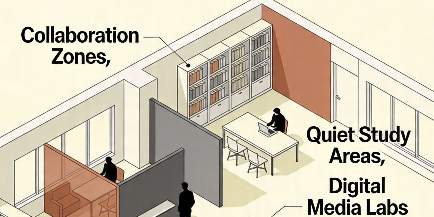
During our library planning studies, we have found that all libraries need environments that allow for social, group and individual study. The library plan should include:
According to “The Future of the Academic Library Symposium: Bridging the Gap, Libraries – “need to be in a state of perpetual beta to effect change.” We believe libraries need to experiment with both quiet and active space.
The University of North Carolina started a Journal of Learning Spaces that is a good place to start an analysis of library space needs. We recommend the journal as a starting point for discussion.
Kindle Lending Library – (e-book) Learning Environment
Posted by acohen in Library Planning Research on May 4th, 2011
Amazon will transform 11,000 library environments with Overdrive. On April 20, 2011, Amazon and Kindle e-reader will work with libraries to provide downloadable e-books. The Kindle library lending feature will debut later this year. Indeed, more than 11,000 US public libraries will have easy access to e-books. This will create new opportunities to transform the library into a learning environment.
In the future, we will see more spaces that provide plug-play technology. We will see libraries with more seats and less collection shelving. The library will strive to be a social space in this new environment. This will increase access to library content and generate communities of practice. Libraries will need space to integrated information literacy programs and offer scholarly aggregation tools.
Watch out – the e-book Overdrive / Kindle is the first out of the gate to transform the way we read at the library.
Future Libraries and Learning Systems
Posted by acohen in Library Planning Research on November 16th, 2010
During our workshop at Steelcase on November 9, 2010, we researched different types of learning spaces. This picture is from the Steelcase worklife building in NYC. It is a good place to experience new types learning spaces to aid in the design of future orientated libraries.
Books, Books and Ebooks – Library Space Planning
Posted by acohen in Library Planning Research on September 28th, 2010
When books were developed by Dutch printers in 1471 they transformed Medieval Life by enabling the distribution of information. Now, consider when paperback books transformed life in the 1960’s and the first penguin books arrived. They were a great invention for the public and much easier to handle while traveling. They were durable and portable for kids to use. They also lowered the cost of literacy so that anyone could have a copy of a best seller or a classic if they wanted.
We are at the edge of a transformation in learning technology and the space requirements to support it. The ebook reader has arrived with a user interface that adds tools to the experience; highlighting, wireless sharing and new requirements for library space. The experience is still at its infancy and only a portion of the population has made the conversion. However, just take a look around at the airport. Many people still use books, but others are already on the hyper-literacy highway. They are traveling at breakneck speeds with new apps designed by developers to enhance the experience.
The ebook is a technology that can bring the book alive. Just look at the additional tools placed on the IPAD. Its ability to be a dynamic wi-if computer or read maps, make notes, play games and puzzles. In the future, there will be more integration with the spatial environment too. For example, library spaces can incorporate (QR) codes, barcodes that, when you take a photo of them with your smartphone, will take you out of the book or item to different websites. It will literally show you additional examples of research or reading on the subject.
Reading is a text based skill and it’s not going away anytime soon. In fact, in most cases a book would work better then a web site. However, publishers need to develop new ways to get readers to buy their books. They need to sell paperback books at a low price, but the real profit will be when they don’t have to spend any natural resources to make the product. When its digital. Paperback books are an inexpensive way to sell information. However, we need to realize that the momentum is being generated by technology companies and publishers that are trying to create new and repeat customer.
For these reasons, we have to focus on the library as a space for books both print and digital. We know the ebook will arrive in greater numbers. That is why we are confident that flexible spaces for leaning needs are available for both. From a collection point of view, we need to make sure we have a repository that supports learning for the long term. However, we can not let the past drive the future of reading and learning. The technology has been let out of the box on a large scale.
To explain how the ebook experience will change the future library we need to continue to read this story. When we see people going from just reading a story into an exploration of a multitude tools and apps that enable sharing we know that library space needs to change. We know that it needs to reflect a new customer, armed with a portal of knowledge under their arm.
The library’s space will be design to allow the users to explore both the individual experiences and collaborative learning. It will be a place that allows you to immerse yourself in a book, but which one will it be? How will this new form of reading to take place without book stacks? And how will this change our use of the library as place?
Further Reading:
Scholarly Information Practices in the Online Environment: Themes from the Literature and Implications for Library Service Development. Report commissioned by OCLC Research. Published online at: www.oclc.org/programs/publications/reports/2009-02.pdf
Library Building ADA Functional Requirements
Posted by acohen in Library Planning Research on July 22nd, 2010
When our firm (ACA) plans and programs a New Library Building we inform our clients that we will be applying ADA standards. We believe it is very important to adhere to ADA building standards set out to support access for people with disabilities.
When we renovate a library building we do a visual assessment. We tour Library areas and/or zones to determine if it provides ADA access or if the building space restrict user flow. Usually, book shelves that haven’t been rearranged for 20 years require rethinking.
Other ADA compliance issues that need to be considered are the staff work areas.